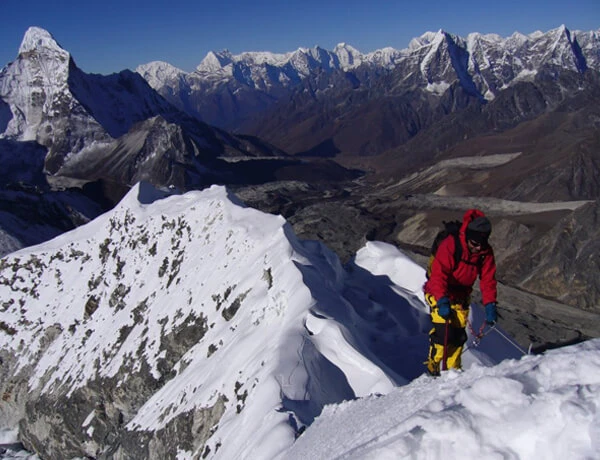
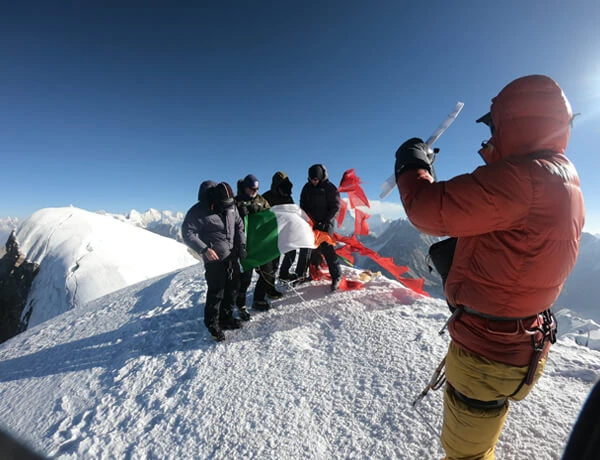
Lobuche East Peak Climbing 3 Days

156 reviews
63 reviews
Recommended by 99% of travelers
At a Glance

The Lobuche Peak Climbing 3-Day package is the best short Himalayan climbing adventure for trekkers who have already done an acclimatization trek in the Everest region. This is an expedition that starts directly from Lobuche and is suitable for climbers who have done the Everest Base Camp Trek, Everest Three Passes Trek, Gokyo Cho La Trek, or the Everest Two Passes Trek. A challenging three-day journey led by experienced local Sherpa climbing experts, combining technical peak climbing, spectacular Khumbu scenery, glacier travel, and a satisfying Lobuche East summit.

Duration
3 Days
Trip Grade
Very Strenuous
Country
Nepal
Maximum Altitude
6,119 m (20,075 ft)
Group Size
2
Starts
Lobuche
Ends
Lobuche
Activities
Peak Climbing
Best Time
Spring (Mar–May) & Autumn (Sep–Nov)
Overview

Stand on one of Nepal's most rewarding trekking peaks and look out at the breathtaking panorama of Everest, Lhotse, Nuptse, and Ama Dablam—an experience you will carry with you for a lifetime.

What is climbing Lobuche East Peak?

Lobuche East Peak Climbing is a guided high-altitude mountaineering expedition to the summit of Lobuche East (6,119 m / 20,075 ft), one of the most celebrated trekking peaks of Nepal, located in the heart of the Khumbu region. Lobuche East sits in the shadow of the giants Everest, Lhotse, and Nuptse, offering climbers a true Himalayan summit experience without the extreme demands of an eight-thousander. It is truly a technical and immensely satisfying achievement involving glacier travel, fixed-rope ascents, and cramponing up steep snow and ice slopes.

Why Choose the 3-Day Package?

The 3-day climbing package is for trekkers who have already spent enough time acclimatizing themselves in the Everest region, most often having completed the Everest Base Camp Trek (EBC) or a similar high-altitude itinerary prior to this. Rather than re-tracing the approach trek (which EBC trekkers have already done), this dedicated 3-day trek efficiently encompasses the last climb from Lobuche village to High Camp and then the summit, allowing you to make the most of your adventure without needless repetition.

Who are we climbing for?

This package is perfect for:

  • Trekkers who have recently done the Everest Base Camp Trek or any other itinerary above the 5,000 meters in the Khumbu region
  • Moderately fit adventure seekers looking for their first Himalayan summit
  • Experienced trekkers looking to advance to technical mountaineering
  • Climbers looking for good preparation for higher altitude peaks such as Island Peak, Mera Peak, Amadablam Expedition or eventually 7,000 m+ objectives

No previous technical climbing experience is necessary, but good experience in high-altitude trekking greatly improves safety and summit success rates.

The Need for Acclimatization

Lobuche East is more than 6,100 meters above sea level—an altitude at which the body is under serious physiological stress. Altitude sickness, in its various forms (AMS, HAPE, HACE), is a real danger above 3,500 m, and the chance of symptoms rises sharply above 5,000 m. Attempting the summit without prior acclimatization is dangerous and greatly decreases the chance of success. The 3-day package assumes that the climbers are already acclimatised to altitude, having spent at least 7 – 14 days trekking at altitudes above 3,500 m.

Why Choose Nepal Mother House Treks & Expedition?

Nepal Mother House Treks & Expedition is a locally owned and professionally managed company run by experienced Sherpa climbing guides with decades of experience in Himalayan mountaineering. Our safety-first approach, transparent pricing, and highly personalized service set us apart. We are dedicated to sustainable, community-based tourism that benefits local Sherpa families and conserves the stunning Khumbu environment.

What is Lobuche East?

Lobuche East is a trekking peak in the Khumbu (Everest) region of Nepal at 6,119 m (20,075 ft). It is one of the most popular climbing objectives in Nepal, famous for spectacular views of Everest, Lhotse, Nuptse, and Ama Dablam and for providing true technical climbing in a beautiful Himalayan setting.

How hard is Lobuche East?

Lobuche East is rated Alpine PD (Peu Difficile – slightly difficult). The ascent involves glacier walking, steep snow slopes of 50-55 degrees, fixed rope sections, and the use of crampons and an ice axe. It is a more technical climb than trekking peaks such as Kala Patthar but less demanding than the upper sections of Ama Dablam or Island Peak.

Is Lobuche East for beginners?

Yes, if you prepare well. Experience with technical climbing is helpful but not required. The key is good physical fitness, good high-altitude trekking experience (ideally above 5,000 m), and having done an acclimatization trek before. Your guide will give you practical training in rope work, crampon techniques, and ice axe work at Base Camp and High Camp.

How long will it take?

3 days to climb, but this package assumes you have spent 10-15 days acclimatizing through an Everest Base Camp Trek or similar itinerary. The total duration of a trip to Nepal is generally 17-21 days.

Do I have to have climbed before?

Previous technical climbing experience is not strictly necessary but is a giant plus. You need to be okay with heights and fit and ready mentally for steep exposed terrain. Our guides give pre-climb training and are with you at every step.

Does acclimatization need to be done?

Sure. Trying Lobuche East at 6,119 m without proper acclimatization is medically dangerous and will almost certainly lead to summit failure. We strongly recommend you have completed the Everest Base Camp Trek or a similar elevation prior to attempting this peak.

How successful is the summit?

With good acclimatization and good weather, the success rate for fit, well-prepared climbers is usually 70-85%. However, attempting the climb without adequate altitude preparation results in a lower success rate.

What permits do I need?

You need 3 permits:Nepal Mountaineering Association (NMA) Trekking Peak Permit, Sagarmatha National Park Entry Permit, and Khumbu Pasang Lhamu Rural Municipality Permit (Trek Cards). Nepal Mother House Treks & Expedition will arrange all the permits for you.


Trip Highlights:

  • Trek to the top of a famous Himalayan summit at 6,119 m—one of Nepal’s best-loved and most rewarding trekking peaks
  • Panoramic 360° views of Everest (8,848.86 m), Lhotse (8,516 m), Nuptse (7,861 m), Ama Dablam (6,812 m), Pumori (7,161 m) and Makalu (8,485 m) from the top
  • Professional Sherpa climbing support from experienced Himalayan high-altitude guides.
  • Get the experience of climbing on fixed ropes—learn how to use ascenders, crampons and ice axes in a real Himalayan setting
  • Spectacular Khumbu Glacier scenery on your way to Base Camp and High Camp across ice towers and crevassed glacier terrain
  • Great Everest Base Camp Trek add-on—use your acclimatisation to the full and add a real summit to your Khumbu experience
  • Small group atmosphere, with a maximum of 12 climbers, for personalized guiding and safety.
  • You can extend your flexible itinerary before or after with trekking extensions across the Everest region.

Why Lobuche East Peak Climbing?

Best First Himalayan Peak

Lobuche East is the perfect balance for trekkers ready to transition from high-altitude walking to real mountaineering. The technical demands are real—you'll use crampons, ice axes, harnesses, and ascenders on fixed ropes—but they’re accessible to fit, motivated beginners under proper guiding. The achievement at the summit is profound, but the climb does not require the months of technical training demanded by higher or more committing objectives.

Everest Region Sceneries

Few places on earth have views as dramatic as those from the summit of Lobuche East. The highest and most iconic peaks on the globe surround you. Below you is the Khumbu Glacier, above you is Everest's South Face dominating the northern skyline, and the razor edge of Lhotse's South Wall is catching the morning alpenglow. This is not a climb; it is an immersion into the most spectacular mountain scenery on earth.

Technical yet Doable

The climb alternates between easy glacier approaches and increasingly steep snow and ice sections in the final scramble to the summit ridge. Fixed ropes have been put in the most difficult sections. The technical difficulties are not beyond the reach of determined, fit trekkers, with good guidance and preparation.

Good Condition for Higher Mountains

Many serious mountaineers use Lobuche East as a stepping stone. The skills you learn—rope work, crampon technique, glacier travel, and high altitude physiology—are directly transferable to higher peaks such as Mera Peak (6,476 m), Island Peak (6,189 m), and eventually mountains like Baruntse (7,129 m),Ama Dablam (6,812 m), or Mera Peak via the classic route. If you are called to the greater Himalayan ranges, Lobuche East is where you start answering.

Personalized Itinerary

Whether you are coming from the Everest Base Camp Trek, the Three Passes Trek, or a customized Khumbu itinerary, we will organize the logistics based on your current schedule, fitness, and ambitions. The 3-day climbing package fits perfectly alongside longer Everest region adventures.

Why You Need To Pre-Acclimatize This 3-Day Package

What is Altitude Sickness?

The body needs time to adjust to the lower oxygen pressure at high altitudes. If you go up too fast, your blood can't supply enough oxygen to your brain, lungs, and muscles. This causes altitude sickness, ranging from the relatively mild discomfort of acute mountain sickness (AMS) to the life-threatening emergencies of high-altitude pulmonary edema (HAPE) and high-altitude cerebral edema (HACE).

The oxygen you have at the summit of Lobuche East (6,119 m) is about 47% of the oxygen you would find at sea level. Even the most fit athletes will struggle or become dangerously ill without prior adaptation.

The Risks of Standing Up Without Acclimatizing

Any attempt to reach a peak above 5,500 m without at least one to two weeks of progressive ascent through the altitude zones is medically irresponsible and extremely dangerous. 

Risks are:

  • Severe headache, nausea and vomiting; close to zero physical capacity
  • Rapid onset HAPE — fluid in the lungs causing breathlessness, which can kill within hours
  • HACE—inflammation of the brain leading to confusion, loss of coordination and unconsciousness
  • Altitude impairs body heat regulation, increasing risk of frostbite/hypothermia
  • In emergencies, the inability to descend safely

In addition to the health risks, climbers arriving unacclimatized almost always turn back before reaching the summit. The 3-day climbing package is not a shortcut but is for those who have done the necessary preparation.

The Proposed Schedule of Acclimatization

The best way to reach the Lobuche East summit is to spend 10-15 days trekking progressively through the Khumbu region before the climbing phase. 

Lobuche East climb after EBC trek

For many trekkers, Everest Base Camp is only the beginning.

Many ask, having stood beneath the world’s highest mountain:

"While I am here, can I climb a Himalayan peak?"

The answer is yes, and Lobuche East is widely considered the best next step.

Here is a sample acclimatization schedule:

Day 1-3: Fly Kathmandu-Lukla and trek to Namche Bazaar (11,283 ft.)

Days 4–5: Acclimatization days in Namche—day hike to Everest View Hotel (3,880 m) or Khumjung Village 

Days 6–9: Trek to Tengboche (3,860 m), Dingboche (4,360 m), and Lobuche (4,940 m)

Days 10-12: Proceed to Everest Base Camp (5,364 m) and Kala Patthar (5,545 m)

Days 13-15: Transition to Lobuche East climb phase

This slow ascent allows your body to produce more red blood cells, to improve your breathing, and to adapt your cardiovascular system to low-oxygen conditions, giving you the best possible platform for a safe and successful summit.

Benefits of Summit Success

Properly acclimatized alpinists always out-perform the under-prepared in every measurable way: higher summit success rates, faster ascent times, better decision-making under stress, and a much lower rate of emergency evacuations. The extra investment in acclimatization is not just a safety measure—it's the most important thing you can do to reach the summit.

Most Popular Trekking Combinations Before Lobuche East 

Everest Base Camp Trek + Lobuche East

Best for: First-time Himalayan climbers and first-time visitors to the Khumbu region on a trekking trip.

The classic mix. The Everest Base Camp Trek (12 – 14 days) takes you to Namche Bazaar, Tengboche, Dingboche, and finally to Everest Base Camp (5,364 m) and Kala Patthar (5,545 m) before returning to Lobuche for the climbing phase. You will have spent two weeks acclimatizing and will already have walked within sight of your objective before you start the technical ascent. EBC + Lobuche climbers have among the highest summit success rates of any combination.

Duration: 17-20 days | Difficulty: moderate to challenging

Gokyo Lakes & Cho La Pass Trek + Lobuche East Ascent

Best for: Trekkers looking for spectacular lake scenery along with a technical summit experience.

The turquoise glacial lakes of the Gokyo Valley, some of the highest freshwater lakes in the world, provide a stunning backdrop to acclimatization. Crossing the high Cho La Pass (5,420 m) and dropping down to the Khumbu Valley and Lobuche you are now ready for the technical climbing phase. This combination is slightly less strenuous than the full Three Passes route but still provides excellent acclimatization and incredible scenery.

Total trip duration: 20–23 days | Difficulty: Moderate–challenging

Lobuche East Climb & Everest Two Passes Trek

Best for: Trekkers looking for a balanced mix of adventure, scenery, and good altitude prep.

This option crosses two of the three high passes on Everest (usually Renjo La and Cho La) and provides excellent acclimatization and reduces total trek time compared to the Three Passes route. You get the confidence of high pass crossings, great views of the Everest massif, and good altitude preparation, all in a more manageable time frame.

Total Duration: 19-22 days | Level of difficulty: Moderate to tough

Everest Three Passes Trek and Lobuche East

Best for: Experienced trekkers looking for maximum adventure and acclimatization.

The Everest Three Passes itinerary is one of the most remarkable Himalayan treks, crossing Renjo La (5,360 m), Cho La (5,420 m), and Kongma La (5,535 m) while linking the Gokyo Valley, Everest Base Camp, and the upper Imja Valley. This long high-altitude traverse gives you excellent acclimatization depth and takes you through some of the most remote and beautiful country in the Khumbu. By the time you reach Lobuche and begin the actual climbing, you will have fully acclimatized to altitude and conditioned your legs. This combination is the best preparation possible for Lobuche East.

Trip length: 22 to 25 days | Trip difficulty: Challenging to strenuous

Where is Lobuche East?

Lobuche East Peak lies in the Khumbu region of northeast Nepal, within Sagarmatha National Park, the protected area that includes Mount Everest and its satellites. The mountain rises above the eastern edge of the Khumbu Glacier at the head of the Khumbu Valley, about 4 kilometers northwest of the famous Everest Base Camp.

The closest permanent settlement is the village of Lobuche (4,940 m), a classic tea house stop on the Everest Base Camp trek. Fly to Lukla (2,860 m) from Kathmandu and trek north through Namche Bazaar,Tengboche, Dingboche, and Thukla Pass following the well-established trail. From Lukla to Lobuche Village, it takes about 8-10 days of comfortable trekking.

Geographically, Lobuche East is located between the Khumbu Glacier on the west and the upper Lobuche Valley on the eastern side. The summit ridge extends approximately northeast-southwest. The actual summit (Lobuche East) is the higher eastern peak; Lobuche West (6,145 m, technically more demanding) lies to the northwest. The summit is part of the prominent ridgeline seen from the Lobuche tea houses, a reassuringly close and well-defined climbing objective.

Lobuche East Peak Overview

History & Popularity of Climbing

In 1984, a party of American climbers made the first ascent of Lobuche East. Lobuche East has seen a steady increase in popularity since the opening of Nepal’s trekking peaks to commercial expeditions and is currently ranked as one of the top five most climbed trekking peaks in Nepal. Its blend of relative accessibility from the village of Lobuche, real technical challenge, and spectacular views make it a perennial favorite among adventure trekkers turning to mountaineering.

Mountain Description

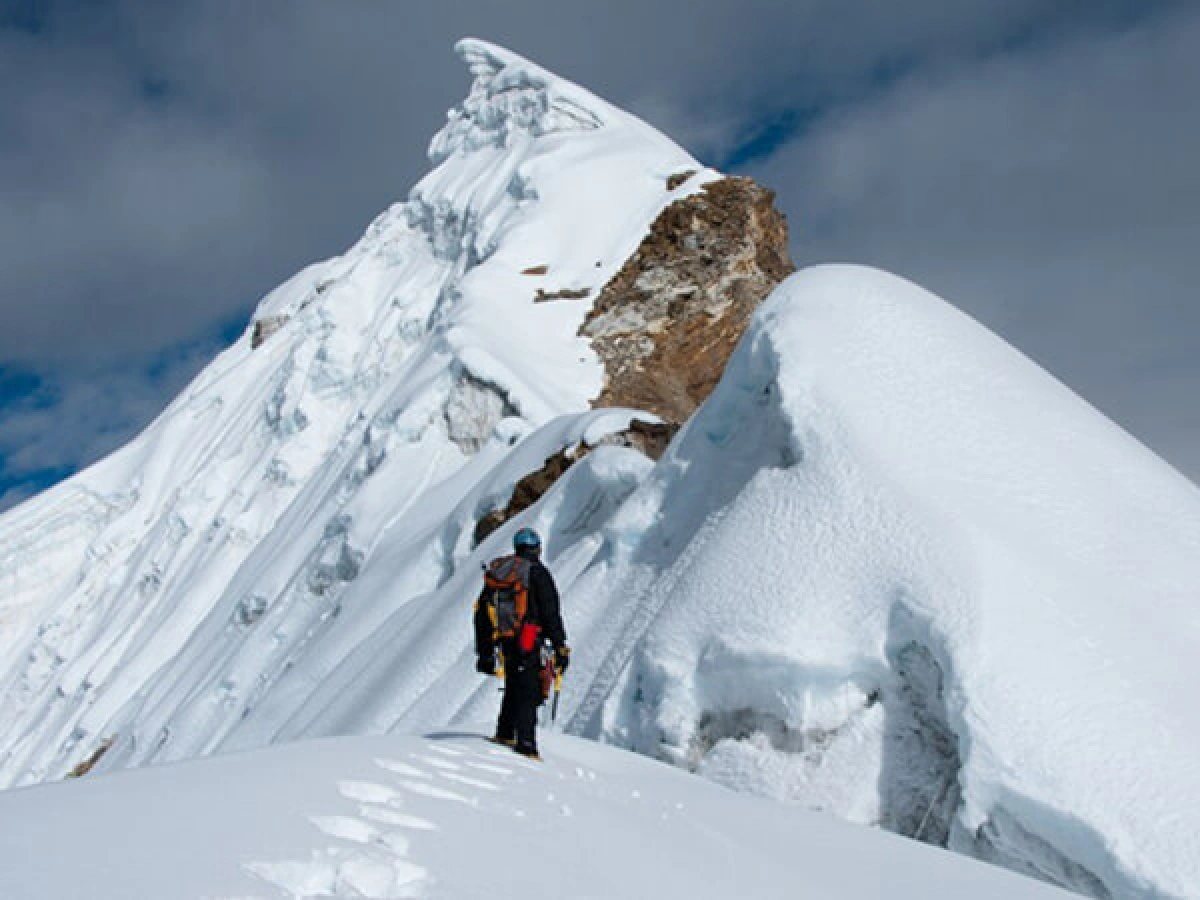
It is a glaciated peak with a broad base rising out of the moraines of the Khumbu Glacier. Snow and glacier terrain takes over from boulder-strewn moraines and rocky lateral ridges that make up the approach to Base Camp at some 4,950m. The summit is a broad snow ridge with a pointed apex and provides unimpeded panoramic views in all directions.

West Peak vs East Peak

Lobuche East (6,119 m) and Lobuche West (6,145 m) are twin summits on the same massif. Though technically the lower peak, Lobuche East is the far more popular climbing objective. Lobuche West is more straightforward, better fixed with ropes, and less technical ice climbing. Lobuche West is an advanced objective that requires much more technical skill and is not normally included in standard trekking peak itineraries.

Highest Point Elevation: 20,075 ft (6,119 m)

Classification: Nepal Mountaineering Association Trekking 

Peak Grade: Alpine PD (not very difficult)

First Ascent: 1984 

Location: Khumbu, Sagarmatha Zone, Nepal 

Coordinates: c. 27°57'N, 86°47'E

Route Summary Approach Trek

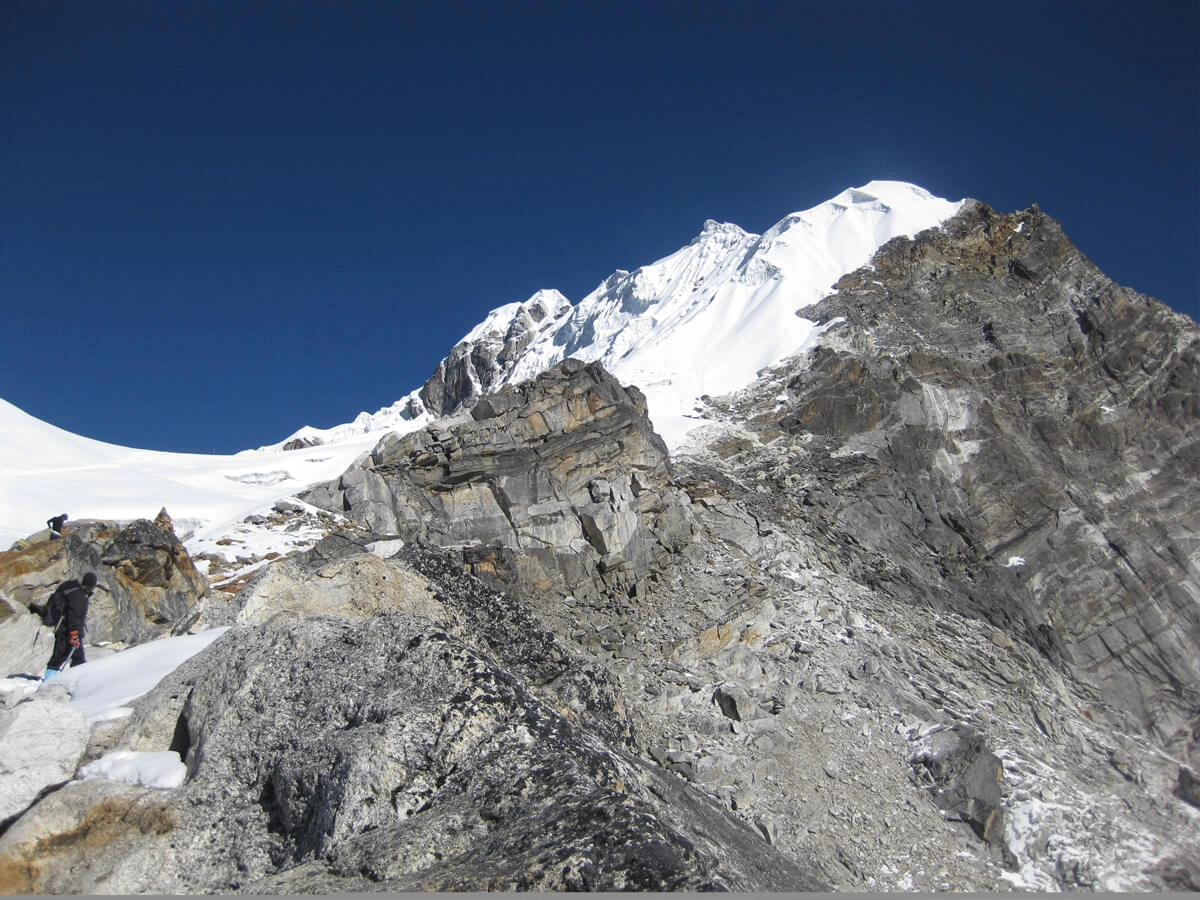
The climbing phase starts from Lobuche village (4,940 m), which most climbers reach after completing the Everest Base Camp Trek or a similar trek. From Lobuche, the route turns south and then west, crossing the rocky lateral moraine of the Khumbu Glacier and climbing through boulder fields to the base of the mountain.

Base Camp (4950 m/16240 ft)

Base Camp is located on a more or less level patch of moraine at some 4950 m/16240 ft. The climbing team then completes equipment checks, technical briefings, and mandatory crampon/rope training. Already the views from Base Camp across the Khumbu Glacier to Pumori, Lingtren and Lho La are spectacular.

High Camp (5,400 m/17716 ft)

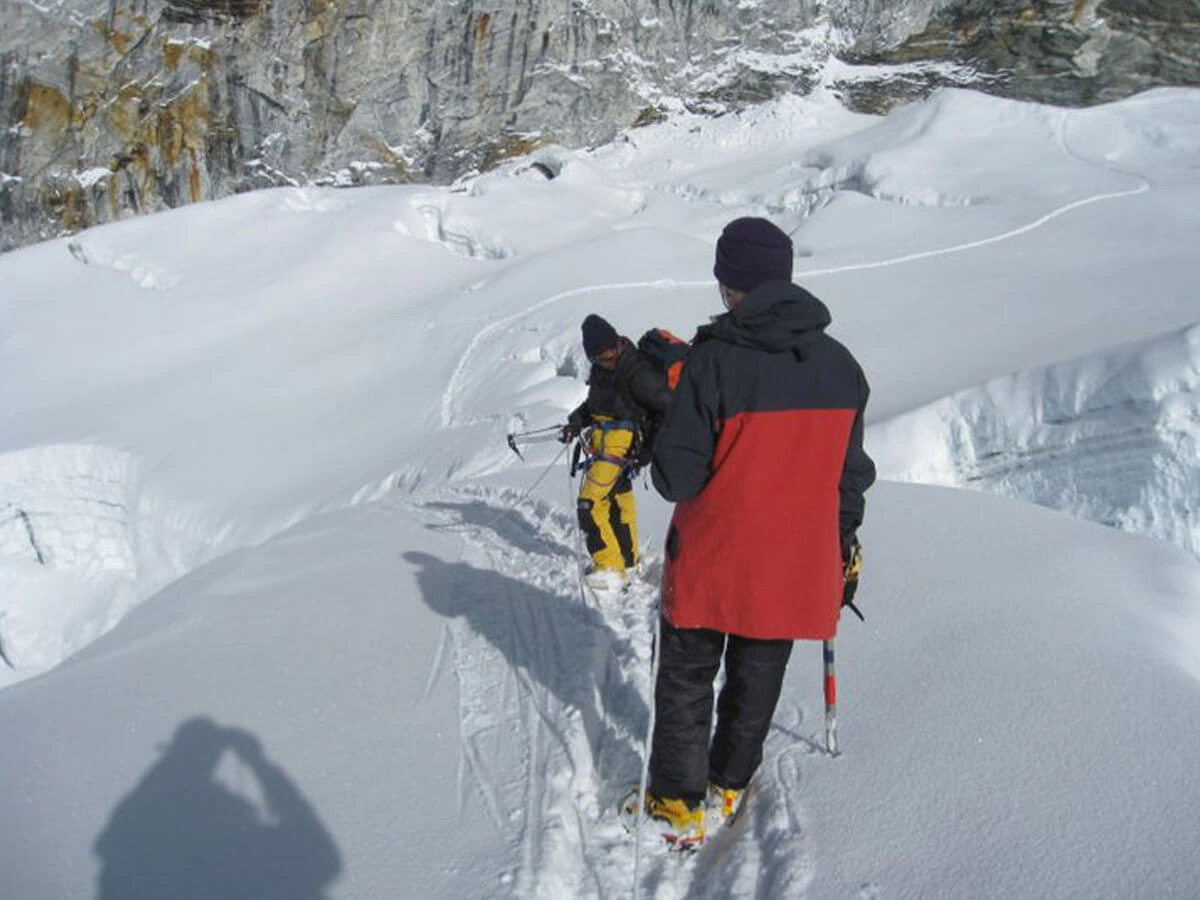
From Base Camp to High Camp, you will traverse glacier terrain and climb steep snow slopes. Fixed ropes are set up on the steeper sections of this approach. High Camp is established on a snow shelf or col at about 5,400 m, where the tents are pitched on a platform cut into the slope. One of the most memorable parts of the climb is the overnight at High Camp—surrounded by towering peaks glowing under stars, altitude air thin and crystalline around you.

Summit Push (6119 m/20075 ft)

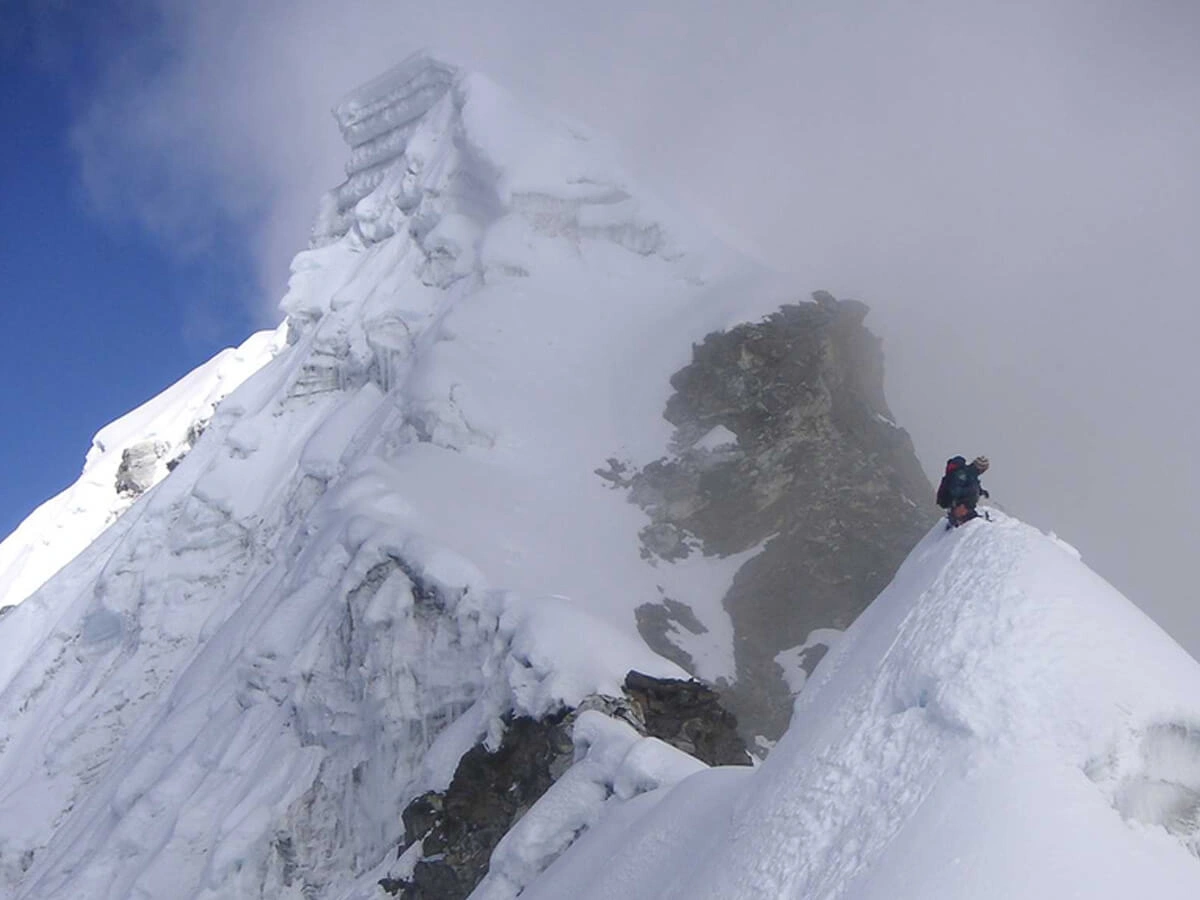
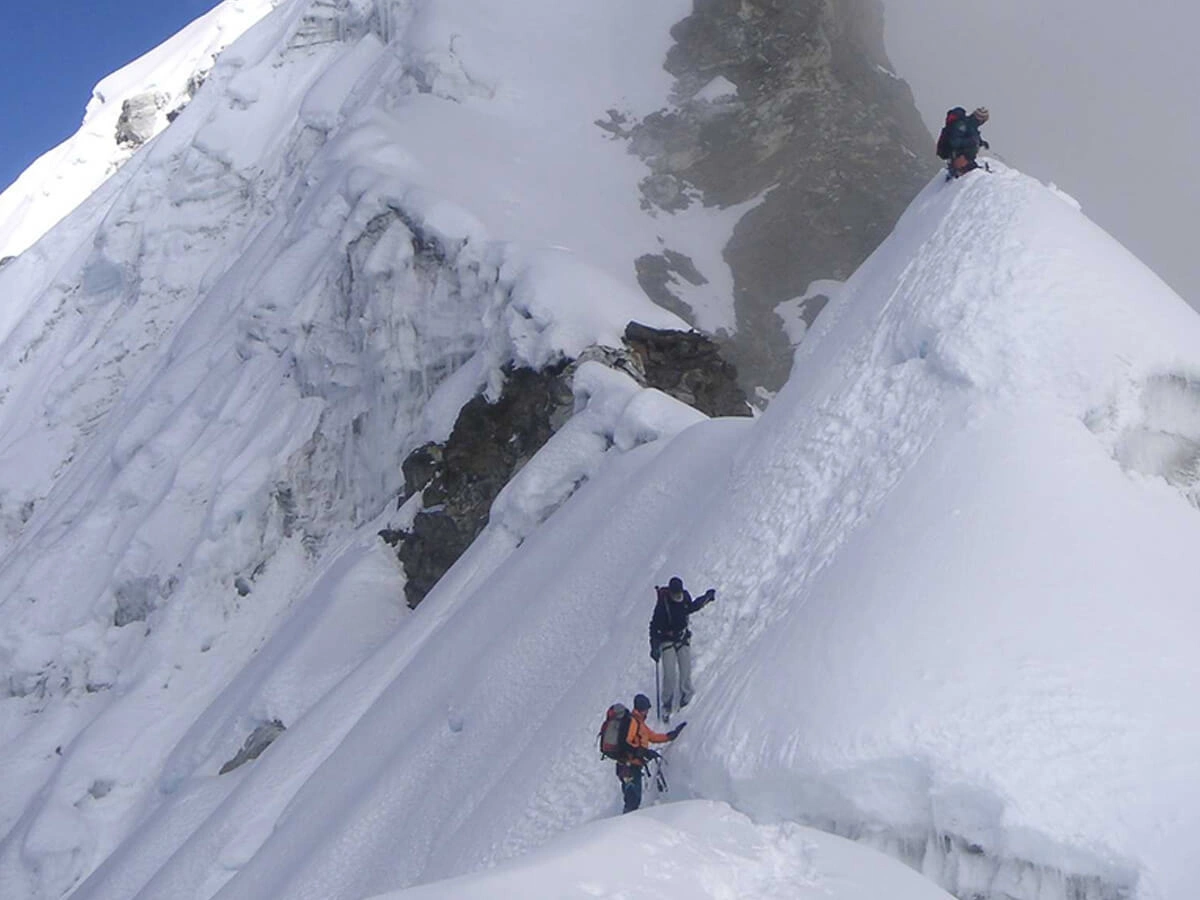
The pre-dawn summit push typically starts between 2 and 4 AM to allow for summiting in the clear morning conditions and a safe return before the afternoon snow softens. The route above High Camp traverses steeper snow and ice, the headwall section reaching angles of 50–55 degrees and featuring fixed ropes for protection. Climbers use ascenders (jumars) to move up the fixed lines; ice axes and crampons are the foundation of security on the steep terrain. The final section is to the summit ridge and the high point, where the views are nothing short of otherworldly.

The Descent

After summit celebrations and photography, the descent follows the ascent route with rappels (abseils) on the fixed rope sections. The descent from the summit to High Camp usually takes between 2 and 4 hours with the right technique and the aid of guides. The climbing phase ends here. After a brief rest and meal at High Camp, the team proceeds with the descent to Lobuche village or Thukla.

Labuche East Peak Climbing Route:

Day 3 is a transition day, open to your wider itinerary. Typical choices are

Option A – Trek towards Lukla: Initiate the descent via Thukla, Dingboche, and Tengboche towards Lukla for a subsequent flight to Kathmandu. The normal time for the trek is 2-3 days.

Option B – Keep the Everest adventure going: Extend your trip with a Gokyo Valley extension, cross the Renjo La or Cho La Pass, or add an Everest Three Passes itinerary extension before exiting via Lukla.

Option C – Helicopter evacuation: If you are short of time, you can choose a helicopter from Lobuche (or nearby Gorak Shep) to Lukla or directly to Kathmandu, weather permitting and at an additional cost.

Difficulty of level:

Lobuche East Peak Climbing is rated Alpine PD (Peu Difficile) in international mountaineering grading systems and is considered challenging to difficult. What this means in practice is the following:

  • Physical challenge: The climb requires sustained cardiovascular work at extreme altitude. The terrain is negotiable but very exhausting for climbers during acclimatization. The day of the summit will involve 10 to 14 hours of active climbing on technical terrain with few opportunities to rest.
  • Technical climbing: The route is a proper mountaineering route, much more demanding than trekking, but accessible to beginners if they are properly trained. Steep headwall sections (50-55 degrees) demand surefootedness on fixed ropes.
  • Ice and snow climbing: The upper mountain is completely covered in snow and glacial ice. Good crampon technique is essential. The fixed ropes reduce the exposure, but climbers must be comfortable on steep, icy terrain.
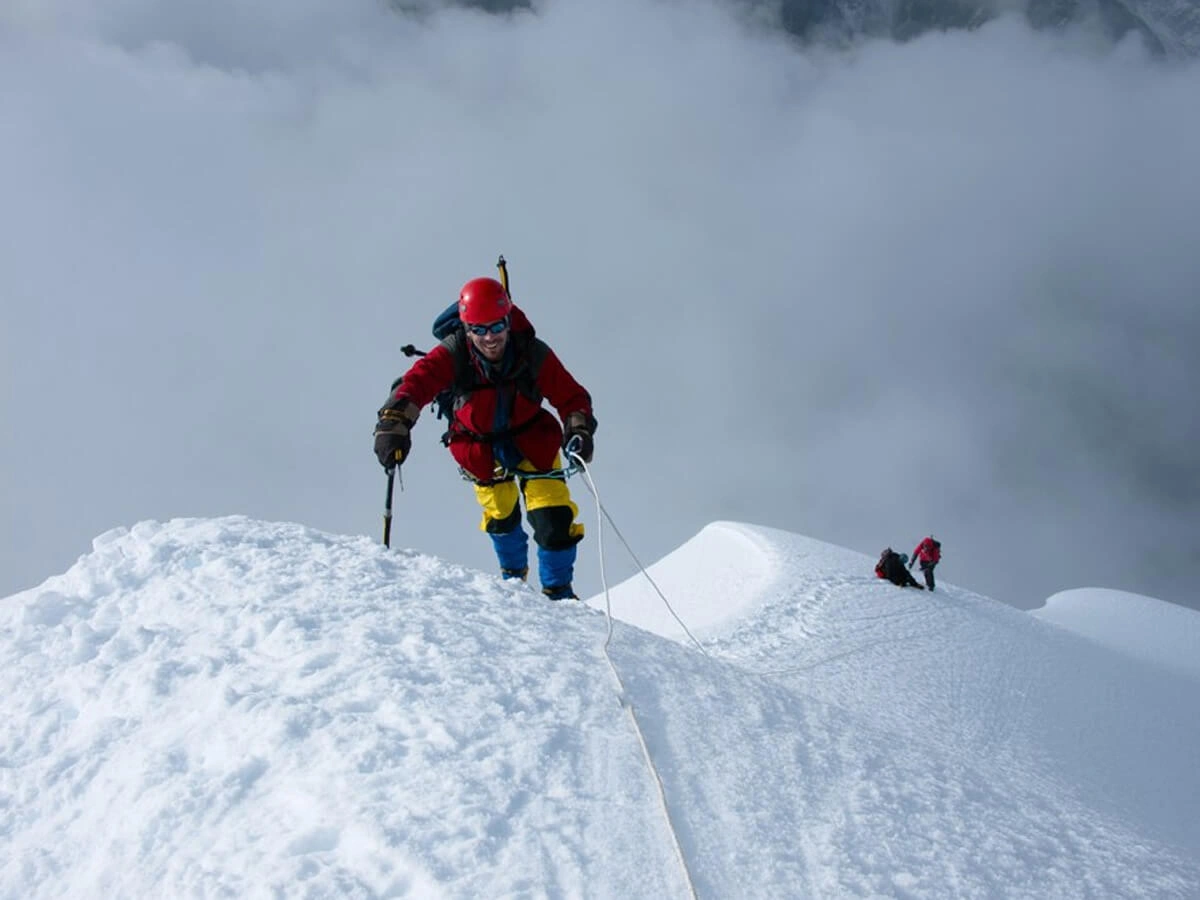
  • Fixed ropes: During the climbing season, all major technical sections are equipped with fixed ropes. Climbers use mechanical ascenders (jumars) on a friction device (ATC or similar) attached to a harness to ascend and descend.
  • Glacier travel: The route from Base Camp to High Camp is on glacier terrain and has a crevasse hazard. All glacier travel is roped and under guide supervision.
  • Fitness requirements: Climbers should be able to trek at altitude for 6-8 hours a day for 10+ consecutive days before the climbing phase. “It’s all about cardiovascular fitness, leg strength, and mental toughness.

Required Technical Climbing Abilities

You don't have to arrive having mastered all of these skills—your guide will provide training at Base Camp—but familiarity goes a long way:

  1. Rope Techniques: Clipping into fixed lines, passing anchors while ascending fixed ropes, and safe rappelling (abseiling) technique on descent.
  2. Crampons: How to fit crampons properly, front-point steep ice, flat-foot moderate snow, and walk with a crampon-safe technique on rocky terrain.
  3. Ice Axe: self-arrest position (stopping a fall on steep snow), rest-step walking, and daggering the axe overhead for balance on steep terrain.
  4. Harness: Proper fit, tying a figure-eight follow-through or clove hitch, clipping/unclipping from anchors with gloves and in cold conditions.
  5. Ascender (Jumar): Securing the ascender to a fixed rope, climbing upwards efficiently with the device, controlling body position, and breathing at altitude.
  6. Descender: Use an ATC or similar friction device for rappelling on descent to control rope friction at various angles.
  7. Safety Training: Altitude illness symptoms and response, partner checking techniques, and guide communication in technical terrain.

Why Book with Nepal Mother House Treks & Expedition?

Deep Khumbu Expertise and Local Ownership

Nepal Mother House Treks & Expedition is a proudly Nepali-owned company, founded by Karna Rana, who has spent his life in the mountains. He has been guiding others on trekking since 2000 as a porter. We’re not a booking agency, nor a foreign-managed operator—we're the guys who will be with you on the mountain. We have direct, up-to-date knowledge of Khumbu terrain, weather, teahouse conditions, and local logistics.

Qualified & Certified Climbing Team

All the lead guides are NMA certified and have summited Lobuche East and other Himalayan peaks many times. Our guides are Wilderness First Responder trained and skilled in altitude illness management and technical rescue. The team you meet in Kathmandu or Labuche is the same team that will take you to the summit. Some of our guides have made more than 35 ascents above 6,000 meters in a single session. So, they are well experienced in climbing. 

A safety-first approach

Safety for us is not a marketing phrase; it is the principle on which every operational decision is based. We keep an eye on the weather, we keep an eye on the climbers’ health with daily oximetry readings, we carry emergency oxygen and communications equipment on every expedition, and we have strict turn-back protocols. We have never put client safety at risk for the sake of a summit, and we never will.

Customizable, flexible itineraries

No two climbers are the same in terms of fitness, schedule, or goals. We offer fully customizable itineraries—whether you want to add the Gokyo Valley extension, include a side trip to Ama Dablam Base Camp, or create a back-to-back Lobuche East and Island Peak expedition, our team will design a program exactly tailored to your goals.

Clear pricing

Nepal Mother House Treks & Expedition has no hidden charges. Please read carefully about the costs included and the costs not included in the package. Quotes are itemized, and any optional extras (personal equipment hire, Kathmandu accommodation, helicopter upgrades) are clearly outlined. You’ll never have to worry about unexpected financial surprises on your trip.

Sustainable, Community-Based Tourism

We feel that the best way to protect the extraordinary environment and culture of the Khumbu is to make sure that the economic benefits of tourism go directly to the people who live there. As we are all local people, we put a portion of each booking fee directly or indirectly into Sherpa community education and conservation programs.

Ready for Lobuche East Summit?

Lobuche East Peak climbing is not just a mountain; it is a transformative Himalayan experience that will permanently expand your sense of what is possible. There is an adventure from the pre-dawn quiet of High Camp to the moment you stand on the summit surrounded by the greatest peaks of the world that no photograph, no film, and no description can convey in full. Nepal Mother House Treks & Expedition is prepared to assist you in this.

Plan your Lobuche East Peak Climbing – 3-day adventure with us today. Our experienced local climbing guides will help you choose the best acclimatization itinerary for your schedule and fitness level, prepare safely and thoroughly for the ascent, and maximize your chances of a successful summit—all while making sure every day of your Khumbu journey is as rich, safe, and memorable as it should be.
Day-to-day

Lobuche East Peak Climbing 3 Days Itinerary

Starts: LobucheEnds: Lobuche

On arrival at Lobuche (4,940 m), your climbing guide, organized through our office with the Nepal Mother House, will meet you. The focus for today is preparing for a safe and successful summit bid.

Your guide will give you a full briefing on the climb and tell you the plan and objectives for the next few days. This means a full inspection of all climbing equipment—harnesses, crampons, ice axes, ropes, and personal gear—and an assessment of each climber’s health and physical condition to ensure everyone is fit for what lies ahead.

Acclimatization note: Lobuche Peak is over 6,100 meters, so we highly recommend that you have previous high-altitude experience before joining this adventure. If you do an expedition that takes you above 5,000 meters, such as the Everest Base Camp trek, the Gokyo Cho La Pass trek, or the Three Passes trek, this will really help your body to acclimatize to the altitude and hugely increase your chances of a successful and enjoyable climb.

Day Highlights

Tents at High Camp Itinerary:

After an early breakfast in your Lobuche tea house, your climbing team meets for a final kit check and briefing on the climb by your lead guide. Here, any necessary gear fitting (harnesses, crampons, helmets) will take place. The team departs via the village of Lobuche, following the rocky moraine trail to the mountain’s base.

The hike to Base Camp takes 2-3 hours of moderate trekking over boulder fields and the glaciated lower slopes. At Base Camp (4950m), the team has lunch, refreshes crampon and ice axe technique, and packs climbing packs for the push to High Camp (5,400 m).

The afternoon ascent to High Camp is the first real technical part of the route, and crampons can be put on as the snow becomes continuous with fixed ropes on the steeper approach slopes. The final push to High Camp is hard but very rewarding. After the tents are set up and the support team has served a hot meal, the evening is spent reviewing the summit plan, sleeping as early as possible, and mentally preparing for the pre-dawn start.

Highlights: the first glacier terrain, dramatic close-up views of the summit slopes of Lobuche East, and arrival at the High Camp with extraordinary evening light on the surrounding peaks.

Day Highlights

The alarm rings in the early hours, usually 2–4 AM, depending on conditions. A quick hot drink and energy snack, and the team dons full technical gear in the dark: crampons, harnesses, helmets, headlamps, and layered clothing for the cold summit push. In Himalayan climbing, one of the most powerful experiences is High Camp in the pre-dawn hours with the world’s highest peaks silhouetted against the stars.

From High Camp, the route steeply ascends the icy couloir above, with fixed ropes securing the headwall sections at 50-55 degrees. The climbers clip their ascenders onto the fixed lines and methodically work their way up, resting when necessary, under the patient guidance of their Sherpa lead. At dawn the eastern sky turns to gold, and one by one the summits of Everest, Lhotse, and Makalu emerge from the darkness, a sight so extraordinary that even exhausted climbers stop to marvel.

The final traverse along the summit ridge reaches the highest point at 6,119 m. From the summit, 360-degree views encompass the entire sweep of the Khumbu's greatest peaks—a panorama few humans on earth ever see from this perspective. Photographs, celebration, and reflection take up precious minutes at the summit before the descent begins.

The team rappels the fixed rope sections and returns to High Camp for a well-deserved rest and meal before continuing down to the village of Lobuche. By evening, they are back at the tea house, the team celebrating with hot soup and quiet satisfaction at having achieved the summit.

Highlights: Early morning summit push. Incredible sunrise over Everest and Lhotse. Technical climbing on fixed ropes. 360-degree summit views. Triumphant walk back to Lobuche.

Day Highlights
Custom Adventures Await
For over 15+ years, we have been pioneers in small group adventure travel, transforming how travelers experience the Himalayas. Discover how we are shaping the future of travel.
Included

Lobuche East Peak Climbing 3 Days Cost Details

Includes

  • Pre-trip meeting in Kathmandu
  • Pre-climbing training at Labuche Peak Base Camp
  • Kitchen equipment, camping tents, dining tents, kitchen tents, toilet tents, tables and chairs, and mattresses for Island Peak Base Camp (Labuche Tea House accommodation = 1, tented camp accommodation = 1, breakfast = 1, lunch = 2, and dinner = 1) per the itinerary. 
  • Equipment includes climbing boots, crampons, helmet, ice axe, harness set (harness, safety rope, 8-finger, ascender/Jumar, 2 locked C/two locking carabiners, BC service), food, and tented camp.
  • Professional Climbing Guide (1:1 Climbing guide) Labuche to Labuche
  • Staff insurance, food, accommodation, wages, and equipment.
  • Climbing peak permit, Garbage deposit fees, and other necessary fees
  • Packed Lunch for summit day
  • Achievement certificate (if you want) 
  • All our services include government taxes.

Excludes

  • Personal mountaineering gear, such as a sleeping bag, a down jacket, gloves, Gore-Tex pants, a water bottle, and hand gloves (you can rent them in Labuche/Chhukung).
  • During the trek, various hot and cold drinks are available, including soft and hard beverages such as drinking water, tea, coffee, and chocolate, as well as snacks like cookies and desserts.
  • Additionally, laundry services, Wi-Fi, battery charging, oxygen, and hot showers are provided.
  • Clients' travel insurance and evacuation (compulsory).
  • A porter will take you from Labuche to Labuche Peak base camp and back to Labuche.
  • A porter will take you up and down to the Labuche Peak base camp.
  • For tipping ideas for climbing guides, USD 100+ minimum is considered fair; however, the amount is from your inner heart.
  • The column includes any items not mentioned above.
  • Your meals and accommodation in Kathmandu and up to Lobuche are also included.
Availability

Departure Dates

Select your preferred date
Sep 2026
Oct 2026
Nov 2026
Dec 2026
Mar 2027
Apr 2027
May 2027
Displaying September Departure Dates
Departure Date
Starts:Sep 15, 2026
Ends:Sep 17, 2026
StatusGuaranteed2 Space Left
PriceUS$869
Departure Date
Starts:Sep 18, 2026
Ends:Sep 20, 2026
StatusGuaranteed2 Space Left
PriceUS$869
Departure Date
Starts:Sep 21, 2026
Ends:Sep 23, 2026
StatusGuaranteed1 Space Left
PriceUS$869
Departure Date
Starts:Sep 24, 2026
Ends:Sep 26, 2026
StatusGuaranteed2 Space Left
PriceUS$869
Departure Date
Starts:Sep 29, 2026
Ends:Oct 01, 2026
StatusGuaranteed2 Space Left
PriceUS$869

Aside from the fixed departure date, we offer daily departures tailored to your requirements during the trekking peak season. Check below for available trip departure dates and costs for Lobuche Peak Climbing.

Are you looking for a Private Trip?
WhatsApp or Call 24/7 @
+977 9841368753
Teams
Trip Experts

For over 15+ years, we have been pioneers in small group adventure travel, transforming how travelers experience the Himalayas. Discover how we are shaping the future of travel.

Jayram Thapa Magar
Jayram Thapa Magar
Trekking Leader
15+
Sabut Thapa Magar
Sabut Thapa Magar
Trekking Leader
15+
Narayan Thapa Magar (Pratap)
Trekking Leader
10+
Bambeshing Jirel
Bambeshing Jirel
Trekking Leader
16+
Mingma Sherpa
Mingma Sherpa
Mountain Guide
10+
Sameer Thapa Magar
Sameer Thapa Magar
Trekking Guide
8
Good to Know

Essential Information

Guide to Fitness and Training

The more ready you are when you arrive, the more you will enjoy the experience. We recommend starting a structured fitness program 3-6 months before your ascent.

Cardio Training:

  • Running: Progress to 45-60 minutes of continuous running at a moderate pace, 4 times a week
  • Cycling (indoor or outdoor): Great low-impact aerobic base training
  • Swimming: Excellent cardio cross-training that also builds upper body endurance
  • Objective: Develop aerobic base to support 8+ hours of continuous moderate effort

Strength Training:

  • Leg press, squats and lunges for quads and glutes (main muscles used in uphill climbing)
  • Loaded pack step-ups—good simulation of stair and moraine terrain
  • Stability drills for uneven terrain (planks, dead bugs, cable rotations)
  • Training grip strength for ascender and rope work

Building Endurance:

  • Long progressive hikes: Train for 6-8 hours with a 10-12 kg pack for 3-4 months.
  • Back-to-back days of training to simulate multi-day cumulative fatigue
  • Hill repeats: Pack climbing up and up steep hills, targeting 1,000+ metres of total ascent each session

Stairway Training:

One of the best and most specific training methods for Lobuche East is stair climbing with a loaded backpack. Use an office building, stadium steps, or a stair machine for 45-90 minute sessions, 3x per week, with 8-12 kg of pack weight.

Altitude Simulation (Optional):

Some elite mountaineers use altitude tents or hypoxic training rooms to partially mimic altitude exposure. These are optional and not needed for most Lobuche East climbers, especially if you do a full Everest Base Camp acclimatization trek beforehand.

Strategy for acclimatization

How height impacts the body

The higher you go, the less pressure the air has. This means that each breath contains fewer oxygen molecules, but the proportion of oxygen in the air (21%) remains the same. Above 3500 m, you start to compensate for your body by increasing your breathing rate, heart rate, and eventually red blood cell production. This process of acclimatization—adaptation—takes days to weeks. Rushing is the biggest cause of altitude illness.

Acute Mountain Sickness (AMS)

AMS is the most common form of altitude illness and is characterized by headache, fatigue, loss of appetite, nausea and poor sleep above 2,500 m. Mild AMS is very frequent and not dangerous if diagnosed early and treated appropriately (rest, hydration, and, if needed, descent or medication). The key is not to go any higher if you are having symptoms.

High Altitude Pulmonary Edema (HAPE)

HAPE (high-altitude pulmonary edema) is a potentially fatal buildup of fluid in the lungs, usually occurring 2-4 days after arriving at a new altitude. Symptoms include shortness of breath at rest, a persistent cough (often productive), extreme fatigue, and cyanosis (blue lips or fingertips). HAPE requires rapid descent and supplemental oxygen if available. It is the number one cause of death at altitude.

High-altitude cerebral edema (HACE)

High-altitude cerebral edema (HACE) is the most serious kind of altitude illness—swelling of the brain causing confusion, loss of coordination (ataxia), severe headache, and eventually unconsciousness. HACE is a medical emergency requiring immediate treatment and descent. Well-acclimatized climbers rarely encounter such a phenomenon.

Principles of Safe Ascent

  • Never climb more than 300-500 m of sleeping altitude per day above 3000 m
  • At least one rest day for every 1000m gained over 3000m
  • Follow the “climb high, sleep low” principle during acclimatization rotations
  • Never Ignore AMS symptoms—if in doubt, descend. Hydration and Nutrition
  • Dehydration accelerates altitude sickness.
  • Drink 3-4 litres of water daily above 3,500 m.
  • Electrolyte supplements maintain mineral balance.
  • Eat high-carbohydrate meals to support glycogen-dependent high-altitude metabolism.
  • Avoid alcohol, which can interfere with your sleep and make dehydration worse.

Best Time to Climb Lobuche East 

Spring Season: March to May (Main Season)

Spring is the best and most popular season for Lobuche East. Average temperatures rise slowly through March and April; the skies are usually clear in the mornings, and stable high-pressure weather windows—essential for summit attempts—are common in April and May. Commercial expeditions typically schedule their summit bids in late April or in the first two weeks of May. The Khumbu trails are crowded in spring, but the infrastructure (teahouse staff, extra supplies, rescue availability) that comes with the high season is a safety benefit.

Autumn (Second Primary Season): September through November

Autumn is the second main climbing season and is characterized by excellent visibility, stable temperatures, and crisp, dry air after the monsoon has left. October and November are normally good, but every now and then the monsoon clouds are still about in September. The crowds in autumn are a little thinner than in spring, and the post-monsoon scenery is gorgeous, with trails washed clean, bright green lower down, and snow sparkling above. In November the cold arrives, and nighttime temperatures at High Camp fall to -20° C or lower.

Winter: December - February (Not Recommended)

Lobuche East is in extreme winter conditions. At High Camp, temperatures can be as low as -30°C and below, storms are more frequent, and the jet stream often dips to heights found in the Everest region, creating dangerous conditions for the summit. In most cases, climbing operations are suspended for the winter. It is not a good season for normal peak trekking operations. However, if you are looking for extreme adventure, we are glad to organize it per your requirements.

Monsoon Season: June-August (Not recommended)

Between June and August, the Khumbu receives heavy snowfalls, continuous cloud cover, poor visibility, and the danger of avalanches from the Southwest monsoon. Trail conditions deteriorate rapidly, and success rates on the summit plummet. It is not realistic to attempt Lobuche East as an objective during the monsoon season.

Season Comparison Table

Season Months Temperature (High Camp) Success Rate Crowds Recommendation
Spring Mar–May -5°C to -20°C Very High High Strongly Recommended
Autumn Sep–Nov -8°C to -25°C High Moderate Strongly Recommended
Winter Dec–Feb -20°C to -35°C Very Low Very Low Not Recommended
Monsoon Jun–Aug 0°C to -10°C Very Low Very Low Not Recommended

Climate and Weather

In the Khumbu region, distinct weather patterns develop from the interaction of the Himalayan range and the South Asian monsoon system.

March: Cold mornings, warm afternoons. Some snow at altitude. More stable conditions late in the month. High Camp temperatures: -10°C to -20°C.

April: Perfect spring weather. Clear in the morning, with some afternoon cloud build-up below the summit level. Wind speeds are moderate at the summit. High Camp: -8°C to -18°C

May: Pre-monsoon season. Highest summit traffic window prior to monsoon arrival. A mist of moisture. High Camp: -5°C to -15°C.

October: Classic clarity after monsoon. Cold, steady, excellent visibility. The perfect autumn window. High Camp: -22 to -10°C.

November: It is getting colder and colder. Early Nov. was good; severe cold increased during the month. High Camp: -15°C to -30°C.

Wind is the key variable on summit day. Gusts above the upper ridges can make summit conditions unreasonable on otherwise clear days. Your guide team will monitor forecasts from professional meteorological services (including mountain-specific forecasting), collaborate with Nepal Mother House Treks, and adjust summit day timing where appropriate.

Accommodation:

Lodging Tea Houses (Lobuche Village):

You stay in well-run teahouses in Lobuche before and after your climb—simple but comfortable stone and timber lodges with twin or shared rooms and blankets. Common facilities include a dining room with a yak-dung stove, basic hot meals, charging  facilities (usually solar, fee-based), and shared outdoor toilets. Now, some tea houses in Lobuche have basic WiFi and attached bathroom accommodation too.

High Camp Tent:

High Camp is located in high-altitude expedition tents, which are double-walled tents built to withstand severe cold and moderate winds. Sleeping bags rated at -20°C or lower are essential. 

High Camp: Your guide team sets up tents and provides a portable stove to make hot drinks and food. Sleeping at high camp is part of the adventure—cold, under the stars, and unforgettable.

Food on the Journey

Lunch at Tea House (Lobuche)

Lobuche tea house menus have a good selection of trekking fare:

  • Breakfast: Porridge, eggs (boiled, fried, or scrambled), toast, pancakes and hot tea or coffee
  • Lunch: Dal Bhat (traditional Nepali lentil soup served with rice), pasta, noodle soups, tuna sandwiches and momos (dumplings) at the lower elevations
  • Dinner: Dal bhat, fried rice, pasta dishes, vegetable curry, soups, yak cheese dishes (locally made)
  •  

Meals in High Camp

Your guide/cook support team will prepare meals at High Camp using a portable stove. The meals are simple but calorie-dense: instant noodles with tuna or cheese, energy bars, hot soups, tea, and coffee. The pre-summit snack (taken in the middle of the night before the summit push) is generally energy bars, hot drinks, and easy-to-digest carbohydrates.

Water:

All water consumed above Lukla should be boiled, treated with water purification tablets, or filtered through a reliable water filter. Nepal Mother House Treks & Expedition will guide you to safe water management during the trip.

Required Permits

Trekking Peak Permit from Nepal Mountaineering Association (NMA)

The NMA Peak Permit is the main climbing permit for Lobuche East. This permit is issued by the Nepal Mountaineering Association, Kathmandu, and must be obtained before the start of the climbing part. The permit fee is seasonal and depends on group size. This permit is arranged by Nepal Mother House Treks & Expedition as part of the package.

Sagarmatha National Park Entrance Permit

All visitors to Khumbu, be they trekkers or climbers, require a Sagarmatha National Park entry permit. This permit supports the protection of the national park's ecosystem, funding conservation and local community programs. This permit is available in Kathmandu or at the entrance to the park in Monjo.

Khumbu Pasang Lhamu Rural Municipality Permit 

All trekkers and climbers entering Khumbu Pasang Lhamu Rural Municipality—the administrative area that covers the Khumbu valley, including the approach route to Lobuche East—require this local area permit. It is issued at checkpoints along the trail and is usually obtained in Lukla or Monjo.

Nepal Mother House Treks & Expedition arranges and coordinates all three permits as part of your package. You don’t have to go through the permit process alone.

Transportation From Kathmandu to Lukla

The gateway to the Khumbu is Tenzing-Hillary Airport in Lukla (2,860 m)—one of the world’s most dramatic airport approaches, with a runway that ends in a sheer cliff face. Several domestic Nepali airlines operate small Twin Otter or similar aircraft on the 30-35 minute flight from Tribhuvan International Airport in Kathmandu to Lukla. Flights usually leave in the early morning to take advantage of the best weather window before the afternoon cloud development.

Flight costs will depend on the airline and season and are usually not included in your package, but if you are taking a trip from Kathmandu to Kathmandu, all are included. All the flights are booked through Nepal Mother House Treks & Expedition.

Helicopter Choices

Helicopter transfers between Kathmandu and Lukla (or higher Khumbu destinations such as Namche Bazaar, Phortse, or Lobuche itself) are possible at a considerable extra cost but allow for speedier travel and more flexibility with schedules. Helicopter charters also serve as the main means of emergency medical evacuation from the Khumbu if a climber needs to be pulled out in a hurry. Travel insurance covering helicopter evacuation is highly recommended.

Flight Delays and Cancellations 

The weather often causes cancellations and delays of flights to Lukla. We strongly recommend including at least 2 buffer days in your itinerary around the Lukla flights—on both arrival and departure—as a contingency for weather disruptions. Nepal Mother House Treks & Expedition monitors the flight situations and proactively informs clients if there are any delays.

Safety Precautions

At Nepal Mother House Treks & Expedition, the safety of our climbers is our first priority. The safety procedures we use are:

Experienced Climbing Guides: All lead guides are Nepal Mountaineering Association certified and have documented high-altitude climbing experience. Ratios are maintained at no more than 1 guide for every 2-3 climbers on technical terrain. Some of our guides climb mountains 30 to 35 times in a single session, so you can imagine how experienced they are during climbing professions.

Emergency Communication: All expeditions carry satellite communicators (Garmin inReach or similar) and HF radios to communicate with Kathmandu Operations and Rescue Services. Also, if you buy insurance with Himalayan Guardian Nepal, they provide a device tracking by GPS or BeiDou Navigation Satellite System; when you need emergency assistance, just press the button, and they will rescue the travelers as soon as possible.

Rescue Procedures: Our guides are trained in wilderness first response, including recognition of AMS/HAPE/HACE, evacuation techniques, and emergency oxygen administration in case of a medical emergency. The helicopter evacuation is organized by existing rescue networks.

Oxygen Availability: On all climbing days above High Camp, the lead guide carries extra oxygen units. Supplemental oxygen is not normally used on ascent on Lobuche East (unlike on 8,000 m peaks) but is available for emergency stabilization during descent if needed.

Pulse Oximetry:  Digital pulse oximeters are used daily from Namche Bazaar onwards to check each climber’s blood oxygen saturation and heart rate—the key early warning signs of altitude illness.

Weather Monitoring: Summit day decisions are based on professional weather forecasts from mountain weather services and live assessment by the lead guide. Climbers are never forced to the summit in unsafe conditions.

Turn-Back Protocol: Our guides have the authority — and the obligation — to turn back any climber who shows symptoms of serious altitude illness, no matter how close they are to the summit. No summit is worth a human life.

Insurance for Trips

High-altitude trekking and climbing require specialist travel insurance. Standard travel insurance does not cover activities above 4,000-5,000 m. Your insurance policy must make provisions for Lobuche East Peak (6,119 m) climbing, for emergency evacuation, and for medication.

Helicopter Rescue Coverage: Emergency helicopter evacuation from the Khumbu can cost US$3,000–7,000 or more. This is the most important coverage item for Himalayan climbers. Make sure your policy clearly includes helicopter rescue up to 6,500 m.

High-Altitude Trekking and Peak Climbing: Your policy should explicitly cover trekking and peak climbing (up to at least 6,200 m) as an activity. ensure the policy isn't voided by the use of crampons, rope, or other technical climbing equipment.

Medical Evacuation: covers ground evacuation and hospital treatment in Nepal and medical repatriation to your home country if required.

Trip Cancellation and Interruption: Covers non-refundable costs if you need to cancel or shorten your trip because of illness, injury, or covered events.

Recommended providers of policies: Himalayan Guardian Nepal, World Nomads, IMG Global, Ripcord Rescue Travel Insurance, and Battleface are some of the providers who cover Himalayan activities.

According to the current guest feedback about services and cost, Himalayan Guardian Nepal is the best insurance for the mountaineering activities because they provide a device to each traveler with a certain amount of secure deposit; the device tracks you by GPS or BeiDou Navigation Satellite System, and you can share your location with your family and friends. And it's easy to call for a helicopter emergency rescue if needed, pressing the button on the device.

But always check the policy exclusions carefully and contact your insurer directly to confirm coverage for the specific activities and altitudes involved. Select better insurance at your discretion.

Climbing Responsibly

As a company, Nepal Mother House Treks & Expedition commits to the principles of responsible, sustainable Himalayan adventure tourism. Our values of environmental stewardship, community empowerment, and cultural respect guide our approach to Lobuche East Peak climbing.

Leave No Trace: All waste generated during the climb—food packaging, human waste, and equipment waste—is carried out from High Camp and disposed of responsibly. Littering will not be tolerated, and all team members must carry a personal litter bag for the duration of the expedition.

Waste Management: Nepal Mother House Treks & Expedition, in partnership with the Sagarmatha Pollution Control Committee (SPCC), ensures all human waste at High Camp is handled according to the latest best practices, including the use of WAG bags (Waste Alleviation and Gelling bags) for human waste containment and pack-out.

Local Employment: All our guides, support staff, cooks, and logistics personnel are Nepali citizens, most from Sherpa communities in the Khumbu. We do not employ foreign guides, nor do we outsource to companies that do. Your booking supports the livelihoods of local Himalayan families.

Cultural Respect: The Khumbu is the ancestral home of the Sherpa people, whose culture is deeply rooted in Buddhist traditions. We ask all our clients to be respectful in monasteries (remove shoes, walk clockwise around stupas, and do not touch sacred objects without permission), in villages, and towards Sherpa staff and community members. 

Do not touch a person’s feet. And don’t share eaten food; it is called Jutho. 

"Jutho" (झुठो/जुठो) is a Nepali word for food, utensils, or things that have become ritually impure by contact with a person's saliva or by being touched by a used utensil/hand while eating. It is a fundamental principle of traditional Nepali (and wider South Asian) food etiquette and hygiene practices.

Key features of Jutho:

  • Once someone has taken a bite of the food, touched it with a used spoon/hand, or it has come into contact with their mouth/saliva in some way, the food becomes jutho.
  • Sharing or eating jutho food with others (except for very close family, such as a mother feeding a small child) is traditionally considered rude or even taboo, especially in religious or ritual contexts.
  • Also applies to utensils—a plate or glass from which someone has eaten or drunk is jutho until washed.
  • In religious settings (temples, pujas, and rituals), jutho is taken even more seriously since purity (cleanliness in a spiritual sense) matters for offerings and rituals. Touching offerings to a deity after they’ve been “tasted” can also change their status—although, interestingly, prasad (blessed food offered to a deity) acts a bit differently and is meant to be shared.
  • The opposite of "jutho" is "chokho" (चोखो), which means clean, pure, or untouched.
  • It’s a practice that’s born out of concerns around hygiene and ritual purity, and it influences quotidian behaviors—such as not eating directly from a shared plate after someone else has, or using a separate serving spoon instead of your own.

Environmental Conservation:

We support the work of the Sagarmatha Pollution Control Committee and contribute to trail maintenance and conservation efforts in the Khumbu. We encourage our clients to consider making a voluntary donation to these organizations as part of their Himalayan experience.

Manual for Photography

Lobuche East is one of the best photo spots in the whole Himalayas. Here's where to take the most remarkable pictures:

  • Sunrise from High Camp:  Set your alarm 30 minutes before the pre-dawn summit push begins and step outside your tent and take in the first light touching the summit pyramids of Everest, Lhotse, and Nuptse. The pre-dawn light, cold blue turning to deep gold alpenglow on ice-covered rock faces, is one of the most dramatic natural spectacles in the world.
  • Summit view: The summit of Lobuche East arguably offers the best 360° panorama of the Everest region from an easily accessible peak. A wide-angle lens will let you capture the full expanse of the Khumbu giants. The north-facing view to Everest's South Face and Southwest Pillar is particularly dramatic when illuminated by the morning sun.
  • Khumbu Glacier approach: The lateral moraine and lower glacier approach have extraordinary icefall-like terrain textures—fractured ice pinnacles, tilted boulder fields, and the huge grey-blue sweep of glacial ice interrupted by the brilliant white of snow-covered slopes above.
  • Everest and Nuptse from Lobuche Village: The rooftops of the tea houses in Lobuche Village offer a classic frame for Nuptse's huge South Face—one of the most photogenic mountain walls in the Himalayas.
  • Ama Dablam views: On the walk down to Thukla Pass, look back south and east for iconic views of the soaring summit of Ama Dablam—arguably the world’s most photogenic mountain—rising above the Imja Valley.
  • Technical tips: At altitude, batteries quickly discharge in cold temperatures. Keep extra batteries close to your body. A mirrorless system camera is much lighter than a DSLR, which is important on summit day. A smaller camera on a chest harness mount or a newer smartphone model allows you to shoot hands-free on the summit push during the most intense parts of the climb.

Plants and animals  

The animals of the Khumbu have adapted extremely well to one of the harshest environments on earth. The climbers on Lobuche East reach the upper areas with little vegetation, and the trek through Sagarmatha National Park is of considerable natural interest.

Himalayan Monal (Danphe): The national bird of Nepal and one of the most beautiful birds in the pheasant family. The male is immediately recognizable by its deep purple, green, copper, and white iridescent plumage. The male is called Danphe, with nine colors, and the female is Monal. It can be found at elevations of 2,500 to 4,000 m, commonly in rhododendron forest belts.

Musk Deer: This rare tusked deer lives in the rocky, open forest areas above Namche. The male has canine-like fangs, a characteristic of musk deer. Musk deer are most active at dawn and dusk. Kasturi Mirga, or Musk Deer, is prized for its gland secretion called "Kasturi." This rare animalic scent was more valuable than gold. Natural deer musk is now critically endangered, so high-end modern perfumers use high-quality synthetic or botanical substitutes to create the rich, warm, earthy scent of natural deer musk. 

Himalayan Tahr: A striking member of the ungulate family related to the wild goat, the Himalayan Tahr is often found on steep rocky terrain between 3,500 and 5,000 m. Males have a prominent mane and are often seen in small herds along the sides of the valley above Namche and Tengboche.

Snow Leopard: The snow leopard is arguably the most sought-after wildlife sighting in all of Asia. It lives in the high rocky zones of the Khumbu above 3500m but is extraordinarily elusive. Dingboche has paw prints in the snow above it, but sightings are very rare and very lucky.  

Alpine vegetation: Above the permanent snowline, the Khumbu is covered in juniper scrub, alpine grasses, mosses, and lichens. Rhododendron forest clothes the lower slopes, a riot of color in April and May; higher up, dwarf juniper, Sunpate Dhup, and above Namche, the alpine meadows of Himalayan wildflowers.

Local Culture Sherpas

Khumbu, heartland of the Sherpa civilization, is the country of a people whose ancestors fled Tibet some 500 years ago and whose intimate knowledge of the high Himalaya has made modern mountaineering possible. The word “Sherpa” is composed of two different words from the language of the Sherpa:“Sher” + “Pa."“Sher” means east, and “Pa” means people. In this way, the Sherpa people are people from the east. It really enhances any climbing experience in the Himalayas to be able to experience a taste and feel of the culture of the Sherpa people. As conservation traditions, some of the family still follow the fraternalpolyandrous marriage system in this region, especially in upper Pangboche village. 

Buddhist Traditions: The Sherpa are followers of Tibetan Buddhism, and the physical landscape of the Khumbu is inseparable from their spiritual realm. The trails are bordered by mani walls (stone walls carved with the mantra Om Mani Padme Hum). Prayer flags on every peak and high pass, blowing blessings on the wind. Stupas (chorten) mark important places, and juniper incense is burned at the puja ceremonies before each climbing expedition, a ritual blessing every responsible climbing team includes.

Monasteries: The most important Buddhist monasteries in the Himalayan world are Tengboche Monastery (3,860m) and Thyangboche Monastery. Tengboche Monastery, rebuilt after a devastating fire in 1989, hosts the phenomenal Mani Rimdu festival in autumn (usually October/November). The Mani Rimdu is a three-day Sherpa Buddhist cultural extravaganza and the prime trekking season is autumn.

Sherpa hospitality: One of the legends known to trekkers in the Himalayas is the warmth and generosity of Sherpa hospitality. The owners of tea houses, the guides, and the villagers go far beyond any professional obligation to make sure their guests are comfortable, safe, and well fed. Such generosity deserves reciprocal respect and sincere gratitude.

Cultural Etiquette: Remove shoes before entering monasteries or gompas. Walk clockwise around all stupas and mani walls. Photography of monks or religious ceremonies is forbidden without permission. Dress modestly, and avoid public displays of affection in villages. The Sherpa communities greatly appreciate such small gestures of cultural sensitivity.

Equipments

Equipment Lists

Checklist of Climbing Equipment

Clothes:

  • Lightweight base layer top and bottom 2x
  • Fleece or softshell jacket midweight
  • Insulated down jacket (800-fill minimum, Summit rated)
  • Waterproof/windproof hardshell jacket and pants
  • 2 x Lightweight trekking trousers
  • Warm climbing pants (softshell or insulated)
  • Gloves, liner, 2 pairs
  • Fleece mittens midweight
  • Expedition mittens (waterproof outer + insulated liner)
  • Balaclava
  • Warm woolen or fleece hat
  • Sun hat/cap
  • Wool/thermal socks, 4-5 pairs
  • Gaiters 

Technical Equipment:

  • Mountaineering boots (double plastic or modern stiff synthetic, compatible with crampons)
  • Crampons (compatible with your boots, 12-point, step-in or semi-step-in)
  • Seat harness (climbing harness, properly fitted)
  • Helmet (climbing approved)
  • Ice axe (general mountaineering, 60-65 cm)
  • Mechanical ascender/jumar (1 unit)
  • Belay/rappel device (ATC or equivalent)
  • Carabiner locks x 3
  • 2 x non-locking carabiners
  • Prusik cord, 6 mm, 60 cm loops x 2
  • Trekking poles (folding, with snow baskets)

Personal Gear:

  • Sleeping bag rated -20°C or lower
  • Liner for sleeping bag
  • Trekking backpack (50-65 liter) + summit pack (20-25 liter daypack)
  • Dry bag or pack cover
  • Spare batteries (lithium recommended for cold weather performance) for the headlamp
  • Sunglasses (Category 4 / glacier glasses – a must above the snowline)
  • Goggles (ski or mountaineering goggles in high wind/snow conditions)
  • Sunscreen (SPF 50+) and lip balm with SPF Trekking poles
  • Water bottles × 2 (1 liter each) + thermos for summit day
  • Camp shoes or trekking sandals for camping in tea houses

Electronics:

  • Smartphone or camera with a protective case
  • Extra batteries and/or power bank (lithium; cold drains batteries quickly)
  • Optional Satellite communicator or personal locator beacon (recommended)
  • Charging cables & universal charger
  • Walkie-talkie (supplied by Nepal Mother House Treks & Expedition)

Medical Kit:

  • Diamox (Acetazolamide):  altitude sickness prevention/treatment (see your doctor before you go)
  • Dexamethasone: emergency for HACE—guide carries, needs prescription
  • Nifedipine (HAPE emergency: carries guide; prescription needed)
  • Headache: ibuprofen or paracetamol?
  • Treatment of blisters (moleskin, tape, blister plasters)
  • Wound closure strips and antiseptic wipes
  • Rehydration packs.
  • Medicine for colds and flu
  • Loperamide (antidiarrheal)
  • Personal prescription medicines in sufficient quantity

Nepal Mother House Treks & Expeditions' guides carry a full group medical kit, oxygen supplements, and pulse oximeters. However, please also bring any medicines you have from your country.

Rental Equipment

If you don’t have your technical climbing kit, there are excellent-quality rental shops in Thamel (Kathmandu) and Namche Bazaar. Furthermore, gear rental is available at Dingboche, Chhukung, and Lobuche per booking. Equipment for rent includes mountaineering boots, crampons, ice axes, harnesses, helmets, down jackets, sleeping bags, and trekking poles. Nepal Mother House Treks & Expedition can suggest trusted rental sources and help organize the fitting of the equipment. 

However, sometimes the rental size may not be an exact match to your body size, so we would like to suggest that all climbers bring their gear for the best performance.

Trip FAQs

Lobuche East Peak Climbing 3 Days FAQs

For spring expeditions (March–May), book at least 3–6 months in advance; they fill up fast. Autumn (September–November) season trips can often be arranged with 2–3 months’ notice, but booking early is always best to ensure permit allocations and preferred guide availability.

Yes. Most nationalities need a tourist visa, which can be obtained on arrival at Tribhuvan International Airport (TIA) in Kathmandu or land border crossings. Visa fees are US$30 (15 days),US$50 (30 days), or US$125 (90 days); bring USD cash even if you are able to pay online and passport photographs. Nowadays, you can apply for a Nepal visa online and pay by card; this process makes it easier when you arrive at TIA, Kathmandu.

See your doctor or a travel health clinic at least 4-6 weeks before your trip. Common vaccinations for Nepal are Hepatitis A and B, Tetanus, Typhoid, Meningitis, and Rabies (for longer stays). Malaria prophylaxis is not necessary at Khumbu altitudes.

Many international carriers have their base at Tribhuvan International Airport in Kathmandu. Some of the popular connecting hubs are Delhi, Mumbai, Doha, Dubai, Bangkok, Singapore and Kuala Lumpur. Most travelers from Europe and North America pass through one of these hubs.

Yes, for sure. Nepal Mother House Treks & Expedition can organize post-trek extensions like Chitwan National Park wildlife safari, trekking in Pokhara and the Annapurna region, such as the Annapurna Base Camp Trek,Langtang Valley Trek, Kanchenjunga Base Camp Trek, Upper Mustang Trek, and the Manaslu Circuit Trek, heritage tours in Kathmandu Valley; and whitewater rafting on the Trishuli River.

Yes, you can do Lobuche East in 3 days—but only if the conditions are right.

The 3-day Lobuche East climbing itinerary is ideal for trekkers who have already completed the Everest Base Camp (EBC) Trek,Everest Three Passes Trek, or any other well-acclimatized route in the Khumbu region. This express itinerary begins from Lobuche Village (4,940 m) and avoids the lengthy trek from Lukla, focusing on the summit climb. Several experienced operators now run it as a specialist extension to the EBC trek.

However, a 3-day itinerary is not safe and not recommended for most international travelers arriving directly from Kathmandu, as there is no time for acclimatization.

You should be able to walk comfortably with a 10–12 kg pack for 6–8 hours per day over consecutive days at altitude. If you can hike all day in the mountains, do a cardio workout for 60+ minutes, and climb stairs with a pack on without getting exhausted, you have the physical foundation. We recommend a structured training program of 3–6 months before attempting the climb.

Both peaks are of similar overall difficulty. The upper slopes of Lobuche East are generally considered to be steeper and more technically demanding (particularly the headwall section). The route to high camp on Island Peak involves more glacier travel. Both are excellent first Himalayan climbs, and climbers sometimes combine them in back-to-back peak-bagging itineraries. Lobuche is technically less challenging than Island Peak.

Mera Peak, at 6,476 m, is generally considered the easier of the two to climb. Mera is less technical, mainly a long glacier walk with a couple of sections of fixed rope. Lobuche East is more technical (steeper headwall, more demanding crampon work) but arguably has more dramatic close-range views of Everest. Mera Peak is often chosen by climbers as their first Himalayan summit before progressing to Lobuche East.

The headwall section above High Camp is the technical crux150-200 meters of 50-55 degree snow/ice ascent on fixed ropes. This section, at 5,900–6,000m with weary legs and thin air, requires full concentration and methodical crampon work. Psychological challenges are the cold and the darkness before dawn. Your guide will be with you on the rope, providing encouragement and guidance along the way.

Your guide is doing daily health checks, including pulse oximetry readings. If a climber develops significant symptoms of AMS, the usual protocol is to stop ascent immediately, rest, hydrate, and take Diamox if appropriate. If symptoms do not resolve within 12 to 24 hours or if HAPE/HACE is suspected, you must descend immediately. Our guides are trained and equipped to handle all altitude illness situations, including arranging a helicopter evacuation if needed.

The most commonly used medication for AMS prevention and treatment is Diamox. It accelerates acclimatization by stimulating breathing. Many climbers take a prophylactic dose (125 mg twice daily starting 1-2 days before major altitude gain) as a safety measure. Check with your doctor before travelingDiamox has side effects (increased urination, tingling in extremities) and contraindications (sulfa allergy, kidney disease). This is not a substitute for proper acclimatization.

Night 1: High Camp (5,750 m). Night 2: Lobuche village (4,940 m). Day 2 provides a valuable physiological recovery as we descend from the summit altitude to the village of Lobuche.

You have already put in a lot of time and effort to get up to the high elevations of the Khumbu, having completed the Everest Base Camp Trek. As your body is already acclimatized during the EBC trek, it helps to get to the summit. Instead of merely seeing Everest, you will actually stand atop a Himalayan peak of 6,119 meters, Lobuche East.

There are plenty of gear shops in Kathmandu's Thamel that rent quality equipment—mountaineering boots, crampons, ice axes, harnesses, helmets, down jackets, and sleeping bags. Gear rental is also available in Namche Bazaar,Dingbuche, Labuche, and Chhukung, but the selection is more limited. For this, you need to order the climbing date. Nepal Mother House Treks & Expedition can recommend reliable rental shops and help arrange the sizing on the pre-climb briefing day in Kathmandu.

Yes, best to have personal crampons. If you don’t have a pair of crampons, you can rent them in Kathmandu or on the trek. If you are renting, test the crampons in Kathmandu with your mountaineering boots before leaving to ensure they fit. Using the wrong kind of crampons can be a real safety hazard on steep terrain.

Your sleeping bag should normally be rated -20°C (comfort rating, not limit rating) at least. Night temperatures at High Camp can easily drop to -20°C or below, so most climbers use a -30°C bag for extra warmth. A liner for the sleeping bag can be washed easily in Kathmandu between treks for 3-5°C extra warmth.

All Nepal Mother House Treks & Expedition guides are trained in wilderness first response and carry satellite communicators or high-frequency radios. If you have a serious medical emergency, our operations team in Kathmandu will arrange helicopter evacuation through their contacts with the rescue networks. All our climbing clients are required to have valid travel insurance with helicopter evacuation cover (minimum US$100,000).

Serious accidents and deaths have occurred on Lobuche East—as on any high-altitude climb—but they are rare. Most incidents are due to lack of acclimatization, bad weather, or falls on the technical sections. Proper acclimatization,experienced guiding, safety equipment, careful weather assessment, and the willingness to turn back when conditions deteriorate significantly reduce the risk considerably.

Yeah. The glacier from Base Camp to High Camp is crevassed. All glacier travel with Nepal Mother House Treks & Expeditions takes place in teams, roped up and under the supervision of our guides. The pre-climb briefing covers the basics of crevasse rescue training.

Nepal Mother House Treks & Expedition will organize all the necessarypermits in Kathmandu before your departure to Lukla. The NMA permit process usually takes 1-2 business days. Please let us know about your trip date. In Nepal, public holidays occur on Saturdays and Sundays, and many festivals take place in October and November, during which the offices will be closed. The package price includes all permit fees.

The Sagarmatha National Park Entry Permit allows general access to the Khumbu trekking area, including the approach to Lobuche. The Khumbu Pasang Lhamu Rural Municipality permit is also a local area permit. Both trekking permits are organized by Nepal Mother House Treks & Expeditions.

Price varies by group size, season, and specific inclusions. About US$ 875 - 950 per person for two people in a group. To get a customized quote, please contact Nepal Mother House Treks & Expedition directly. All quotes are clear and itemized, including all permits, guide fees, accommodation, and meals as specified in the inclusions list.

In addition to the package cost, budget about US$20-40 per day for personal expenses in the Khumbu (hot showers, battery charging, WiFi, cold drinks, and snacks). For normal accommodation in Khumbu: US$5–10 per night and meals of 30 to 40 USD per day before and after the expedition. Include equipment rental, visa fees, airport taxes, and tips for your climbing team.

The date of summit day is always dependent on the weather. If weather conditions are unsafe for a summit attempt on the scheduled day, your guide will evaluate the conditions and place a one-day weather hold if conditions are expected to improve. Extended weather delays of more than a day can mean a failed summit attempt—a natural risk of high-altitude climbing that no operator can promise to avoid. Furthermore, plan to include at least one extra day as a contingency day. We recommend trip interruption coverage as part of your travel insurance.

Nepal Mother House Treks & Expedition uses professional mountain weather forecasts from services like Meteoblue Mountain Forecast, as well as real-time assessment of wind speed, cloud formation, temperature, and barometric pressure by our lead guide. On summit day decisions are conservative;we don't push clients up the mountain in marginal conditions.

The Tenzing-Hillary Airport in Lukla is renowned for its weather-related cancellations. Cloud cover, high winds, and poor visibility can cause the airport to close for 1-4 days in a row, especially in spring (when afternoon thunderstorms often develop) and during the monsoon season. We highly recommend including at least two buffer days in your Kathmandu return schedule and booking international flights with sufficient flexibility.

A helicopter transfer is an alternative to fixed-wing flights between Kathmandu and Lukla. Helicopters can often fly in conditions that would ground fixed-wing aircraft, although they too have weather limitations. Helicopter costs are not included in the standard package but can be arranged at an extra cost. There is also road access to Surke, which is a 1 to 2 hour walk from Lukla, and from there you can drive back to Kathmandu on an adventurous 16 to 18 hour drive.

Most tea houses in Lobuche have twin-sharing rooms, though a few have a limited number of private rooms available for a single supplement. Accommodation in Lobuche is limited, and pre-booking of private rooms is recommended, especially in the busy spring and autumn seasons.

At most Lobuche tea houses, you can take a hot shower for a small extra charge (typically NPR 500-1000 / US$5-8). Solar heating is usually used for hot water, and it may be limited in the early morning or late evening hours.

Get in touch with Nepal Mother House Treks & Expedition through our website, email, or WhatsApp (+077-9841368753) to discuss your dates, preferences, and any customization requirements. Once confirmed, we will send you a booking form and invoice for your deposit. Normally, a 10-20% deposit secures your booking, with the balance payable before departure. You can pay by card online or by wire bank transfer.

Policies on cancellations vary by season and package. Cancellation Policy: If you pay the full package payment,Nepal Mother House Treks & Expedition offers a partial refund for cancellation before 60 days of departure and reduces the amount of the refund for less time. However, the advance payment for trip booking is nonrefundable but secure for a lifetime; you can use this amount at any time in your lifetime, either for yourself or for your friends or family. We highly recommend travel insurance that includes trip cancellation coverage.

Yes. Nepal Mother House Treks & Expedition has group departure dates in spring and autumn seasons. These departures are available for solo travelers and generally include 2 to 8 climbers. Contact us for today’s group departure dates. But we highly recommend a 1:1 guide for first-time climbers for the best success rate.

Solo climbing is not permitted on Nepal’s trekking peaks without a guide. All climbers must have a licensed guide with them. For single bookings we have a 1:1 guide-to-client ratio, meaning you get our undivided attention throughout all technical sections.

Yes. Women climbers are a large and growing part of Lobuche East’s summit parties, and many of Nepal’s top mountaineers are women. It is not a question of gender that determines summit success but of physical fitness, mental determination, and proper acclimatization. Nepal Mother House Treks & Expedition has been successfully leading many women to the summit of Lobuche East and welcomes solo women travelers and women-only groups.

Nepal Mother House Treks & Expedition is committed to promoting women in Himalayan guiding, which has traditionally been male-dominated, and can arrange female assistant guides on request, subject to availability. It’s best to book some months in advance to secure them.

To fly a drone in Sagarmatha National Park, you need a special permit from the Nepal Civil Aviation Authority and the Department of National Parks. Drones are not allowed to be flown in the national park without permission, and violators can be fined and have their equipment seized. If you want to arrange the flight officially, Nepal Mother House Treks & Expedition can advise on the drone permit process. But it has quite a long process to obtain.

Lighter is better on summit day – every extra gram counts at 6,000+ m. A mirrorless camera system is much lighter than a DSLR camera system. Use a wide angle for summit panoramas and a mid-range zoom for glacier and approach photos. Keep the camera body warm (inside your jacket) to prevent battery failure in extreme cold. A waterproof camera bag and lens filters (UV, polarizer) are recommended.