One of the fascinating region to make you rejuvenated…………………..
The Kanchenjunga Base Camp Trek explores the eastern part of the great Himalayas and leads you to the north base camp of the third-highest mountain in the world, Mt. Kanchenjunga. The region borders Sikkim, an Indian State, and Tibet of China. In 1988, Kanchenjunga was opened to foreign travelers, and since then, only a handful of trekkers have traversed this region because of its isolation and challenging terrain. Now, trekking in the Kanchenjunga region has become one of the premium routes in the Himalayas. The trek to Kanchenjunga Base Camp is strenuous and presents a wilderness venture.
Kanchenjunga is also known as the "Five Treasures of the Great Snow: Gold, Silver, Precious Stones, Grain, and Holy Scriptures." Likewise, in the Sanskrit language, Kanchenjunga means "Beautiful Wide Hips of Virgin Girl (Deities)," the two words Kanchen and Junggha. Trekking through the beautiful Arun Valley, you will ascend toward the base camp. The trail goes through the Kanchenjunga Conservation Area, home to some endangered species like snow leopard, Bengal tiger, red panda, Himalayan Black Bear, Assamese macaque, and numerous exotic birds. Likewise, you will pass by dense forests of rhododendrons and bamboo, along with cascading waterfalls and remote villages.
The Kanchenjunga Trekking route includes a diverse variety of terrain, from sub-tropical forests to alpine grassland that further goes to the low river valley, glacial moraine, and rugged scree slopes. Along with the Kanchenjunga Base Camp Trekking trail, you can see panoramic views of many hills and Himalayan mountains like Mt. Everest (8,848 m), Mt. Lhotse (8,516 m), Mt. Makalu (8,481 m), Kabru Peak (7,412 m), Mt. Jannu (7,710 m), Mera Peak (6,476 m), Rathong (6,682 m), and numerous others. Likewise, the trail also offers breathtaking landscapes.
You will cross the main four passes at Ghunsa from the south side of Sele La Pass (4,240 m) / Sele La High Camp, Sinion La Pass (4,440 m), Mirgin La Pass (4,480 m), and Sinelapche Bhanjyang (4,636 m) during the trek. While passing through the villages, you will get to see the lifestyle and rich culture of the locals. There are many monasteries and Stupas on the way as well. The Kanchenjunga Trek is a once-in-a-lifetime journey that offers an experience unlike any other place. You will learn many life lessons while trekking.
It is hard for us to give you the best picture of the trail, as it is amazing and changing with every new village. And believe us, it only gets better. You can also add Kanchenjunga South Base Camp Trek to the journey to take it to the ultimate level. For more information regarding the Kanchenjunga Base Camp Trek cost or any queries, contact us anytime.
How many permits are required for the Kanchenjunga Trek?
You need to get a special trekking permit from the Nepal Tourism Board because the Kanchenjunga region is one of the restricted areas of Nepal. Likewise, you also have to get the Kanchenjunga Conservation Area Permit. To get these two permits, you need to have a valid passport (at least six months of legality) and a visa.
- Restricted Area Trekking Permit: USD 20 per person per week
- Kanchenjunga Conservation Area Permit: NRS 2,000 per person or equivalent foreign currency
As it is a restricted area, there are a couple of other rules travelers need to follow to trek.
- There should be at least two trekkers in the group, not including the guide and the porters
- You must trek with a licensed travel company (all the permit costs are usually added to the total package cost)
Kanchenjunga Trek: Approximately Cost
Kanchenjunga Trek Cost covers all the necessary permits, accommodation, and meals on the trail. Similarly, the package cost also includes expenses and insurance for guides and porters, along with all the ground transportation as per the itinerary. Depending upon the services that you are using on the trail and your expense habits, the overall cost of the Kanchenjunga Tea House Trek might differ slightly.
As per the Nepal Government rules, you cannot trek to Kanchenjunga Base Camp alone anyway, so having a trekking agency arrange all the things makes the journey less hectic, and you will get plenty of time to enjoy. Please be aware that the package price does not include your expenses for travel insurance, tickets, and shopping. If you book Trek now, we have an early bird offer for autumn and spring 2024/2025.
What Kinds of Accommodation Are Available on Kanchenjunga Trek?
Kanchenjunga Base Camp Trekking is a homestay and teahouse trek. The trail is not developed and bustling like other famous trekking regions. The available services are very basic and get limited with the increase in elevation. You will be spending nights in the teahouse or homestay on the trail. The rooms are twin-sized with double mattresses, pillows, and a few pieces of furniture. Likewise, the washroom may be private or common, depending upon the place. We always advise you to get a warm sleeping bag because the rooms are not heated and can get cold in the mornings and nights.
Plan Your Kanchenjunga Base Camp Trek at the Best Time
The best time of the year to go on Kanchenjunga Base Camp Trek 24 Days is in spring (March to April) and autumn (October to November). Trekking to Kanchenjunga Base Camp in these two seasons is comparatively comfortable and easier than in other seasons. The stable weather and moderate climate are all you need for a pleasant journey in the Kanchenjunga region, which is available in these two seasons. The views are clear and fantastic.
Trekking in winter is not a wise choice. The temperature drops below -12 °C at the base camp, and strong wind makes the journey challenging. Most of the trail gets covered with a thick layer of snow, and crossing the passes becomes very difficult and risky. Similarly, the monsoon increases the chances of floods and landslides in the region. The trail gets muddy, slippery, and full of bugs. Winter and monsoon both are off-season and not a good time for Kanchenjunga Trek.
Can I go to Kanchenjunga Base Camp, Trek Solo?
The Kanchenjunga Trek Route is more challenging and off-beat than other trekking trails in the Himalayas. This trail is known for its adventure, remoteness, and challenges. Trekking alone in this part of the Himalayas is not a good idea, even if you are an experienced trekker. The trail is not crowded and less developed. You might not see anyone along the way most of the time as well.
Moreover, considering the fragility of the region, the Nepali government has issued certain rules that foreign trekkers have to follow to trek here. One of them includes trekking with a travel agency and a guide, with at least two trekkers in the group. It means you are not allowed to trek solo in the Kanchenjunga region.
What is the Difficulty Level of the Kanchenjunga Base Camp Trek?
Kanchenjunga Base Camp Trekking trail ranges from moderate to strenuous. You have to be physically fit with previous trekking experience to go on this trek. The route is off-beaten, with numerous rugged and steep sections that demand strength and stamina. You have to walk 6 to 7 hours daily. Likewise, the remoteness of the region and limited facilities add to the difficulty of the trek. Kanchenjunga Base Camp Trek is no joke, and you have to be properly prepared and well-equipped.
You also have to be aware of altitude sickness during the trek, as it is a high-altitude journey. As the elevation increases, the air will get thinner with low pressure and oxygen levels. Go on short hikes and exercise to increase your core strength before the beginning of the trek. It will help you a lot on the trail. We have designed our Kanchenjunga Base Camp Trek itinerary, adding ample rest days for acclimatization that will help you avoid altitude sickness, and our professional team will also take care of you.
Here is Kanchenjunga Base Camp Trek Suggested Itinerary
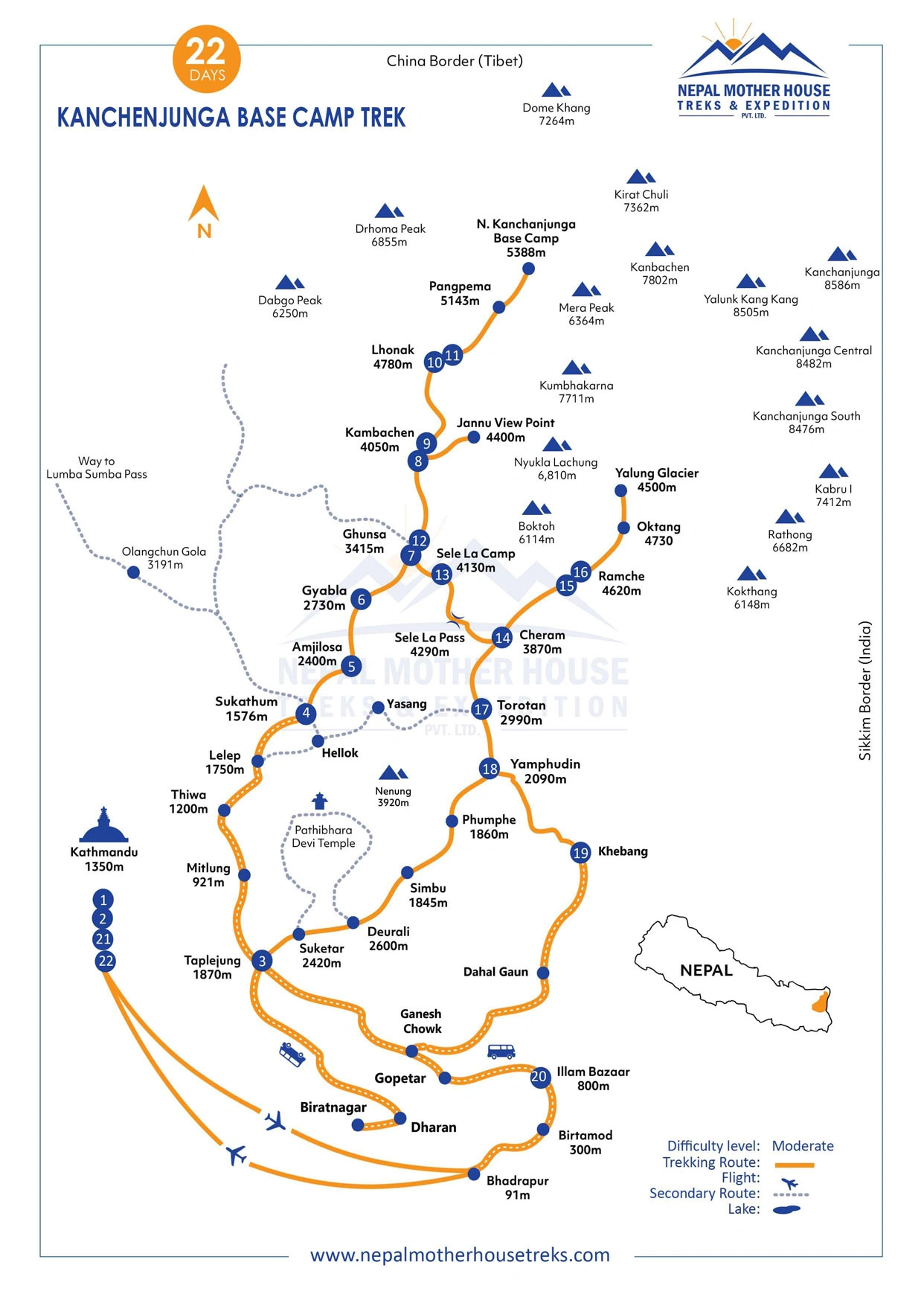
Your arrival day and the second day are free to relax and prepare for the trek. On the third day, you will fly from Kathmandu to Bhadrapur and drive to Taplejung. It is the starting point of the trek. Trekking through small villages and rice paddies, you will reach Mitlung and move towards Thiwa. The trail goes along a river and crosses a suspension bridge. You reach Taplethok and ascend to Lelep, the headquarters for the Kanchenjunga Conservation Area Project (KCAP). From here, the trail follows Ghunsa Khola and crosses a few bridges before Amjilosa arrives. However, nowadays, access is limited up to Sukathum/Japantar (1576 m), so you will drive 5 to 6 hours by Jeep.
Further, the trail gradually ascends through lush forests of rhododendrons and junipers to Ghunsa and continues towards Kambachen, where you take a rest day off. You will hike to Khumbhakarna View Point / Jannu View Point, which offers stunning views of the snow-capped mountains, and on the next day, trek towards Lhonak. Where you can see the Holi serenity of Kirat under huge builders. This is the place where Maha Guru Phalgunanda (Phalgu Nath Ananda was born on November 11, 1885, in Chukchinamba village, Ilam district, Nepal, and passed away from his physical body on April 4, 1949) meditated. According to the Holyness Great Master Phalgunanda, this is the Holi site (Phaktanglung) of the Kirati people. Phaktanglung means shoulder of man; it is the shape of Mt. Kumbhakarna and looks like the shoulder of a man. They must visit this place at least once in a lifetime. Mt. Kumbhukarna became the name of the Kumbhakarna, who was one of the devil brothers of the Ravana, King of Lanka (Srilanka). He was a very interesting character in the Ramayana in Treta Yuga; he had a gigantic body, was a powerful warrior, and used to sleep for six months.
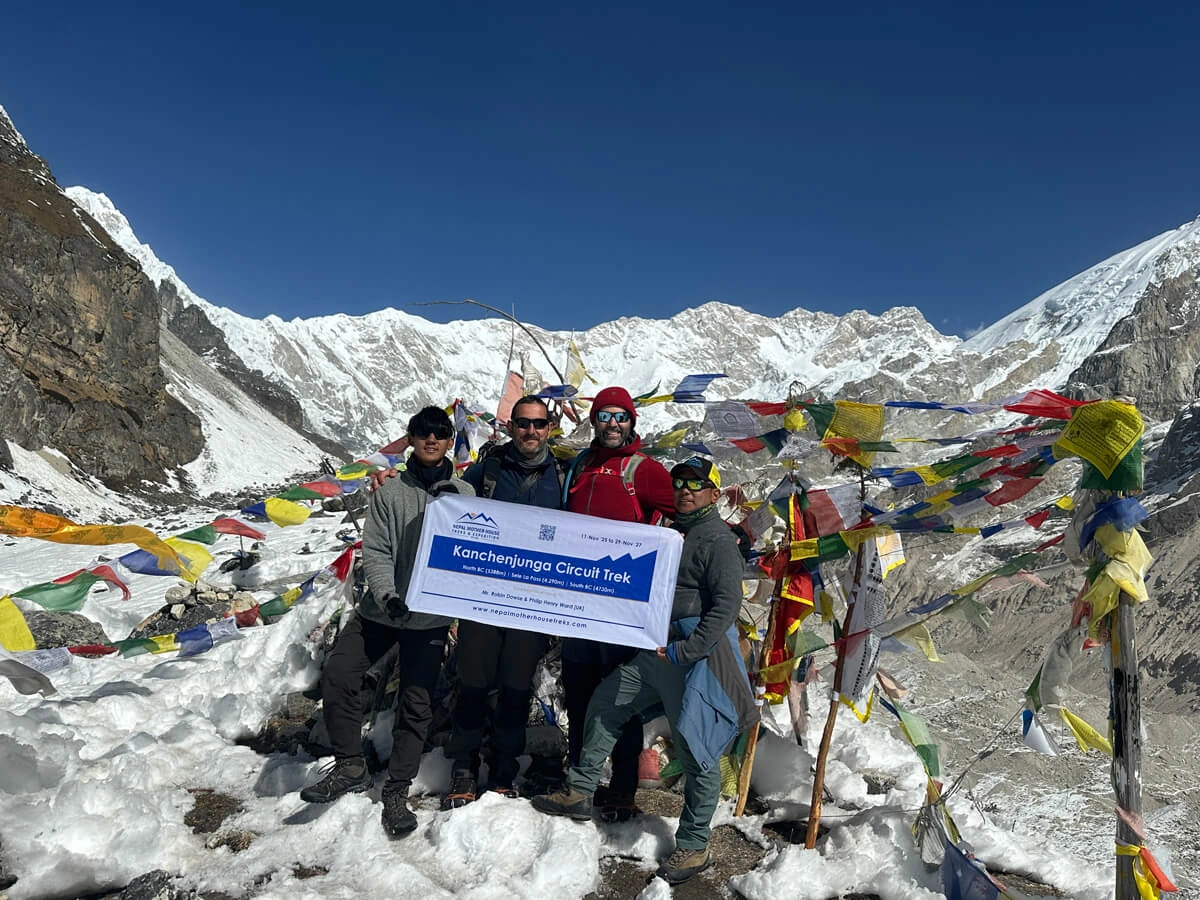
The trail from here leads to Kanchenjunga North Base Camp. You will spend the night in Pangpema, which is a few hundred meters below the base camp. At the Sele La pass (4,290 m) on the top, there are two tea houses for the overnight stay, so this is also known as Sele La High Camp. This trek is also known as the Kanchenjunga Circuit Trek.
From here onwards, after a 2 hour's walk, you will cross the Sinion La Pass (4,440 m) and pass by Mirgin La Pass (4,480 m) and Sinelapche Bhanjyang (4,646 m) before reaching Cherma after a 2 to 3-hour's walk. Sinelapche Bhanjyang is the highest pass on the Kanchenjunga trek by Himalayan Map house. So, it should be the name of SELE LA PASS. Leaving Cheram behind, you ascend to Yalung Glacier via Ramche. Follow a downhill trail to Tortang, Lamite Bhanjyang that further leads to Yamphudin. The trail mostly sees downhill paths and goes through remote villages like Khebang (1910 m) and Khamdime/Happu Khola (1500 m) before you take a drive to Illinois. Driving via Bhadrapur, you move back to Kathmandu.
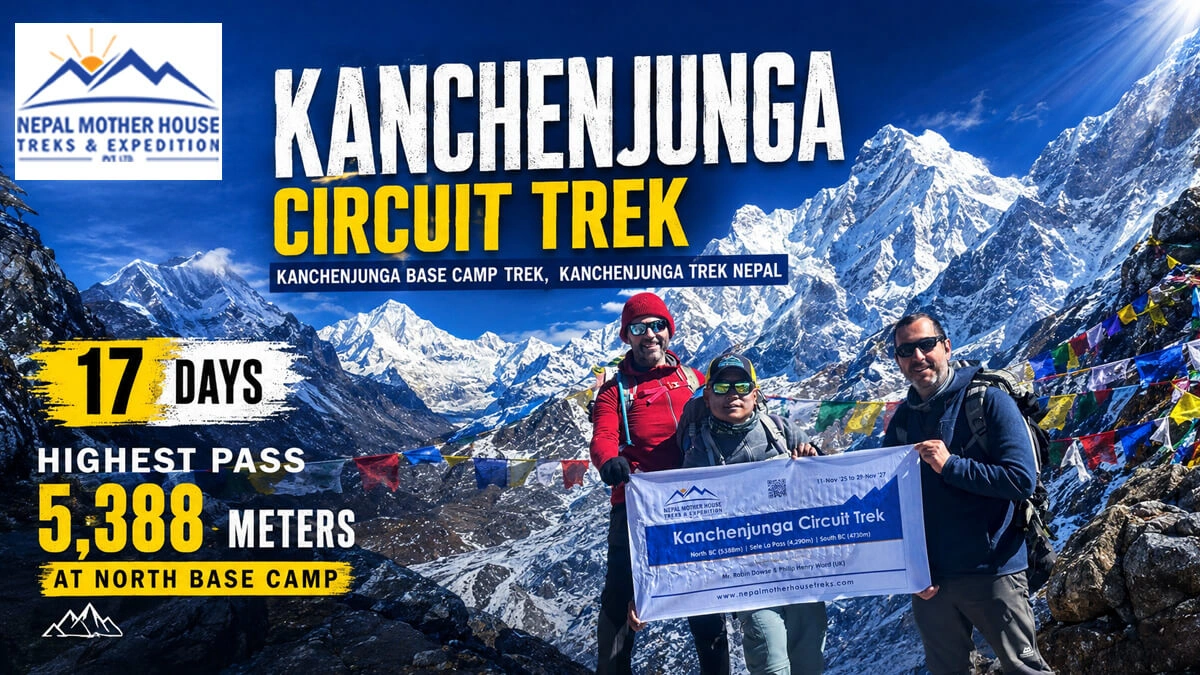
Kanchenjunga Trek Route can be different depending on your choice and holiday schedule. Kanchenjunga Short Trek can be done in 7 days in the shortest time and fly to and back at Suketar. It can combine with the north and south base camps for the Kanchenjunga Circuit Trek for 17 days as well.
Highlights:
- Adventurous, wild, and off-beaten trail Trek to the base camp of the third highest mountain, Mt. Kanchenjunga
- The trail goes through the Kanchenjunga Conservation Area, home to numerous species of rare flora and fauna
- If you are lucky, you might get to see a glimpse of a snow leopard, Bengal tiger, red panda, Himalayan Black Bear, and exotic birds
- The trail goes through dense forests of rhododendrons and bamboo Trek through picturesque Arun Valley
- Get to see the daily lifestyle and traditions of locals while trekking through remote villages
- Explore 3rd highest mountain in the world, Mt. Kanchenjunga South Base Camp
- Cross three passes: Mirgin La Pass, Sinion La Pass, Sele La Pass, and Sinelapche Bhanjyang
- Witness breathtaking sceneries, stunning glaciers, and panoramic views of the Himalayan mountains.
- Visit the Jannu View Point (4,400 m) and the Kirati people, known as the "Holi site" (Phaktanglung) for the best picture.