The Kanchenjunga South Base Camp Trek package is a tough, high-commitment trek in eastern Nepal that is best for experienced trekkers who would prefer be outside than in a cozy place. This nine-day journey is offered by Nepal Mother House Treks. It includes domestic flights, long jeep rides, all the licenses you need, licensed guides, and modest accommodation in tea houses. The walk goes on for about 4,500 to 4,700 meters to Yalung South Base Camp and Oktang Viewpoint. The best times to do this hike are in the spring or fall. You should have trekked before you go, and there aren't many places to stay or eat along the way. You should also be able to change your plans depending on the weather and the conditions.
Kanchenjunga South Base Camp Trekking
This Kanchenjunga South Base Camp trip package takes you deep into the Himalayas, away from other people, for hikers who wish to be alone in nature. It's perfect for experienced hikers who can handle long days of climbing, little conveniences, and changing weather in the mountains.
You fly and drive to the far east of Nepal, then hike through calm towns, thick woods, and high alpine valleys for roughly two weeks, including travel time. The path takes you slowly to the southern base of Mt. Kanchenjunga, which is the third-highest mountain in the world. This hike isn't really special. There aren't many other places to eat other than tea houses, and in certain cities, like Ramche, there aren't many good places to stay. Instead, you have peace and quiet, room to roam around, and a sense of adventure that most hiking routes don't have anymore. It's not simple to climb to the Kanchenjunga South Base Camp; you have to be dedicated.
You will know for sure if this walk is good for you once you read this page. It will depend on your fitness level, how much time you have, and how comfortable you are.
Who would benefit most from this Kanchenjunga South package
This Kanchenjunga South Base Camp trek package includes getting you to and from Kathmandu, a good trekking guide, all the permits you need, and basic tea house lodging along one of Nepal's most isolated trekking routes. The journey goes to the south side of Mt. Kanchenjunga, which is not near the busy hiking areas of Everest and Annapurna. People who have traveled to high locations before, can walk for a long period, and know that plans may change because of bad weather, bad roads, or airplane delays, will enjoy this trip. The trail goes through little towns in the country, woods, hillsides that can slide, and high alpine areas where there aren't many tourist facilities yet.
Who should pick a different trek?
If you wish to stay in nice locations, take hot showers every night, have a lot of places to eat, or go on short walks every day, this trip isn't for you. If this is your first hike in Nepal or you only have 5 to 7 days to travel, you should head to a different part of the country.
Kanchenjunga will reward those who are patient and ready. It's a serious trekking that is planned and done slowly.
The greatest 9-day tour to Kanchenjunga South is organized by Nepal Mother House Treks. You fly to Bhadrapur first, and then you drive back quickly via the Tamor Corridor Highway. At 4,620 meters, the Yalung Glacier is the highest point on the trek. In 2026, it's a terrific hike for anyone who like to be active.
Important Points
- The Kanchenjunga area is a wild part of the Himalayas that is very far away. You don't see any other trekking groups for days, and the vistas are huge and clear.
- Getting to South Base Camp: The last few days take you near the great south face of Kanchenjunga, where you can see glaciers, moraines, and the beautiful Yalung glacier, Yalung Base Camp, and Oktang viewpoint.
- Traditional Villages: The lower parts go past Rai, Limbu, and Sherpa villages, where daily life goes on as usual, without tourism affecting it.
- Basic Tea House Life: The rooms are small and made of wood, and there are locations where people may hang out together. It's particularly easy in higher places like Ramche.
- An Actual Adventure: This is more like an adventure than a normal lodge tour. Here, planning, keeping up the pace, and working together are all very important.
The "Giant's Sprint" Itinerary for Kanchenjunga South Base Camp
This schedule is for the 2026–2027 season. It moves quickly and requires a lot of physical fitness. We put your safety first at Nepal Mother House Treks while giving you a real, genuine Himalayan experience.
| Day | Route | Max Altitude | Trek/Drive Time | Highlight |
| 01 | KTM → Bhadrapur → Ilam | 1,210m | 45m Flight + 3h Drive | Kanyam Tea Gardens |
| 02 | Ilam → Yamphudin | 2,090m | 9–10h Jeep | Cultural Gateway |
| 03 | Yamphudin → Cheram | 3,870m | 8–9h Trek | The "Vertical Day" |
| 04 | Yalung Glacier / Ramche | 4,620m | 8–9h Round Trip | Face of Kanchenjunga |
| 05 | Cheram → Tortang | 2,990m | 6–7h Trek | Rhododendron Forests |
| 06 | Tortang → Kyangsara | 2,140m | 4–5h Trek | River Valley descent |
| 07 | Hellok → Taplejung | 1,820m | 3h Trek + 5h Jeep | Return to Civilisation |
| 08 | Taplejung → Dharan | 80m | 5–6h Jeep | Tamor Corridor Views |
| 09 | Dharan → KTM | 1,350m | 1h Drive + 35m Flight | Victory Toast in KTM |
Hike up to the Kanchenjunga South Base Camp
-
What kind of gear do I need to hike to the Kanchenjunga South Base Camp?
Wear warm, layered garments, a down jacket with insulation, waterproof clothes, strong hiking boots, and a sleeping bag that will keep you warm the whole way to Kanchenjunga South Base Camp. You should also carry a flashlight, a power bank, a water filter, and your own first-aid kit because the facilities aren't very nice.
-
What is the best way to get to the Kanchenjunga South Base Camp?
Most of the time, you travel from Kathmandu to Bhadrapur in eastern Nepal to get to Kanchenjunga South Base Camp. After that, you drive a car down long mountain roads to the base of the ascent.
Things can go wrong on travel days, and they might be long, so it's crucial to be able to change your plans.
-
What kinds of motels and tea houses are there on the way?
In locations like Kathmandu, you stay in regular tourist hotels, while along the way, you sleep in little tea houses. The rooms are simple, and most of the time the bathrooms are shared.
At higher elevations, you might not be able to take hot showers. "Tea houses are safe, but they aren't very nice."
-
What kinds of food can you eat while hiking on Kanchenjunga?
The food on the Kanchenjunga hike is modest and made to order. Dal Bhat, which includes rice, lentils, and veggies, is what most people consume. You might also see noodles, soup, eggs, and tea. In the highlands, food often comes with fixed menus that don't have many options.
-
Do I need a guide to help me go to the Kanchenjunga South Base Camp?
To get to the Kanchenjunga South Base Camp, you need a qualified trekking guide.
You need a registered guide to hike here.
-
Why do you need a guide to hike in Kanchenjunga?
Because Kanchenjunga is far away, has few amenities, and the weather can change fast, a guide is quite vital. A licensed guide handles permits, navigation, altitude safety, and communication. Nepal Mother House Treks' guides are trained, have trekked at high altitudes before, and are insured for your protection.
-
Do I need help getting my things to the Kanchenjunga South Base Camp?
You don't have to hire a porter by law, but it's a good idea. The expedition will last for many days and involve a lot of walking over tough ground. You can only carry a light daypack if you have a porter, which is better for your body.
-
How does Nepal Mother House Treks pick its porters and guides?
We only hire guides who have a license and experience and porters who have the right insurance. We pay our team members appropriately, instruct them about altitude, and make sure they know the Kanchenjunga circuit well. This makes sure that our guests' hikes are safer and more moral.
-
Can porters and guides acquire insurance?
"Yes." Nepal Mother House Treks uses guides and porters who are legally required to have insurance, as is needed by Nepal trekking rules. Insurance protects you from the risks of hiking and the problems that can come up while you're on the trail.
-
Is it safe to hike Kanchenjunga with a guide?
"Going on a trek to Kanchenjunga South Base Camp is hard and far away." But if you have the right clothing, set realistic goals, and hire experienced guides and porters from Nepal Mother House Treks, it can be a safe and fun trip into the jungle.
-
What are the good things about hiking with Nepal Mother House Treks?
"Tell us how much trekking experience you have, how much time you have, and how comfortable you are if you're not sure if the Kanchenjunga South Base Camp trek is right for you." We'll give you a straightforward and honest answer before you book.
Questions that individuals who wish to hike Kanchenjunga typically ask before they make a reservation
1. How do you go to the Kanchenjunga South Base Camp?
The Kanchenjunga South Base Camp trip brings you to a rural part of eastern Nepal that is near to the south face of Mt. Kanchenjunga, which is the third-highest mountain in the world.
2. How hard is it to walk to the Kanchenjunga South Base Camp?
The long days, high altitude, and distance from the site make it hard on the body. It's great for folks who have traveled to high places before.
3. How long does it take to get to the Kanchenjunga South Base Camp?
The hike itself normally takes 9 days, but the whole trip, including getting there and back, can take 12 to 14 days.
4. Do you need a guide to trek in Kanchenjunga?
Yes, you need a licensed guide since there are places you can't go.
5. Should you visit Kanchenjunga's South Base Camp?
Yes, for hikers who like to be alone, go to wild places, and travel in a real way instead of for comfort and ease.
6. Is it tougher to get to the base camp for the Kanchenjunga trip than the base camp for Everest?
The trek to the Kanchenjunga South Base Camp is harder than the trek to the Everest Base Camp because it is farther distant, takes longer to get there, has fewer places to stay, and has fewer ways to get out. Only people who have hiked at high heights before may do it.
7. How far away are more hiking trails from the Kanchenjunga South Base Camp?
Kanchenjunga South Base Camp is a long way away. There aren't as many tourists, hotels, or phone service here as there are on Annapurna or Everest.
8. Is it possible to get to Kanchenjunga South Base Camp without camping?
"Yes, you can usually do the Kanchenjunga South Base Camp trek without camping, but the tea houses are very basic."At certain periods of the year, you might need help camping.
9. How much more does it cost to hike in Kanchenjunga than in Annapurna?
Trekking in Kanchenjunga costs a lot more than hiking in Annapurna since there are fewer area permits, guides are needed, transportation routes are longer, and there are more charges related to getting things done.
10. What do you do if the roads or planes are canceled?
If flights or roads are canceled, schedules may vary. That's why Kanchenjunga needs more time and the right travel insurance.
11. Is it typical for people to get sick because this path is so high up?
You can develop altitude sickness, but it's not very common if you go at the correct speed and give yourself enough time to get used to the higher altitude. The road goes up slowly, but you have to be careful because it's so far away.
How to Make a Reservation for This Kanchenjunga Package in 2026 and 2027?
It's a big trip, so you should look over the packages carefully before you plan a hike to the Kanchenjunga Base Camp.
"If you're thinking about the Kanchenjunga South Base Camp trek, let Nepal Mother House Treks know how much hiking you've done before, when you're going, and how comfortable you are. We will give you a good plan before you book."
"This hike isn't for everyone." If you inform Nepal Mother House Treks about your past trekking trips, we can help you figure out if Kanchenjunga is the perfect one for you.
Outline Itinerary
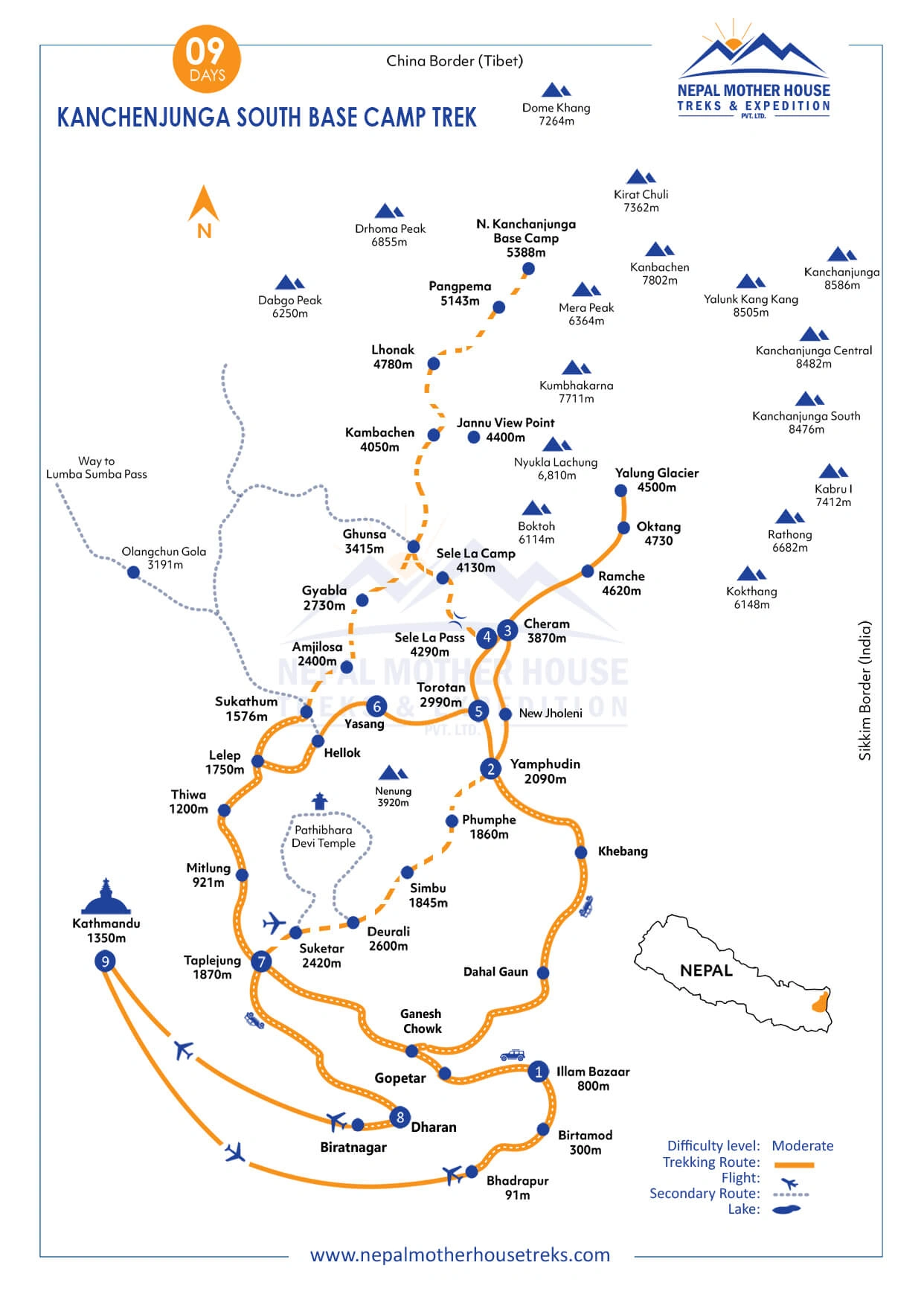
Fly from Kathmandu to Bhadrapur (91 m)—45 minutes—and drive to Ilam (1,210m) by private Jeep -2 ½ to 3 Hours.
Drive Ilam to Yamphudin (2090m) -9 to 10 hours
Trek Yamphudin to Cheram/ Tseram (3,870m) via New Jholeni —7 to 8 hours
Explore day Yalung Base camp (4,500m), Oktang Viewpoint (4,730m) via Ramche (4,620m), return to Cheram/ Tseram (3,870m) -8 to 9 hours
Trek Cheram/ Tseram to Tortang (2,990 m)—6 to 7 hours
Trek Tortang to Kyangsara /Ysasang (2,140 m)—4 to 5 hours
Trek Kyangsara /Ysasang to Hellok, Ranipull (1,530 m)—2 to 3 hours & Drive to Taplejung (1,820) -4 to 5 hours
Drive Taplejung to Dharan (80m) -4 to 5 Hours by bus /jeep via Dharan, through Tamor Corridor Highway.
Drive from Dharan to Biratnagar (80m) – 1 to 1 ½ hours—and fly to Kathmandu—30 to 35 minutes.

Photo Gallery


Kanchenjunga South Base Camp Trekking Itinerary
In the morning, you'll be taken to the domestic airport for a beautiful trip from Kathmandu to Bhadrapur in eastern Nepal. The 45-minute trip gives you a chance to see rivers, hills, and the wide plains of the Terai region. This is a big change from the mountains you will soon be in.
Your private jeep ride to Ilam, a lovely hill village known for its tea gardens, starts after you land in Bhadrapur. The drive takes about 2.5 to 3 hours and starts in the sweltering lowlands and goes up into the cooler, greener highlands.
As you go up, the view changes to rolling hills with tea plantations, cardamom fields, and little villages. Ilam is tranquil and pleasant, making it easy to get used to the more remote areas that come next.
When you get to Ilam, you settle into a hotel or lodge. You can relax or take a brief walk around town in the afternoon. Ilam is a great place to relax after a long day of travel because it is quiet and has fresh air.
Place to stay: lodge or hotel in Ilam
Breakfast is the first meal of the day.
Walking: Very little
Tea gardens and beautiful hills in eastern Nepal are the best parts.
Today we have to drive a long way to get to the Kanchenjunga area. This is very crucial. You take a private jeep from Ilam to Yamphudin after breakfast. Yamphudin is the last significant town before the real trekking trail starts.
The trek lasts 9 to 10 hours and travels through quiet countryside, narrow mountain roads, and river valleys. When you climb in one of Nepal's most isolated districts, you should be ready for rough ground, places that are likely to slip, and a slow pace.
On the journey, you go through old towns, terraced farmland, suspension bridges, and deep woods. At a roadside stop, you can have a simple but full Nepali meal for lunch.
As you go closer to Yamphudin, the world around it seems to move farther away. The contemporary world fades away, leaving only serene views and a calm life in the highlands. You can unwind at a simple yet nice tea house when you arrive there.
Your guide will talk to you tonight about the hike you will be doing tomorrow to make sure you are ready in both body and mind. Going to bed early is a good idea.
It's pleasant to stay at the tea house in Yamphudin.
There are meals for breakfast, lunch, and dinner.
Please be patient; the drive is long and there are a lot of hills.
Today is the start of your mission. Once you leave Yamphudin, the path goes up quickly through woods of bamboo, rhododendron, and pine. It's easy to see the path, but it goes up all the time, so be careful and take your time.
As you ascend higher, the air gets thinner, and the area around you starts to appear more like the Alps. You cross small creeks, waterfalls, and even wooden bridges. There aren't as many villages anymore; instead, there are high meadows and places for animals to graze.
You can see a lot of different things after you leave New Jholeni. When the snow peaks start to show, the feeling of being alone gets stronger. The last section of the climb to Cheram (Tseram) is hard, but the view of the mountains makes it worth it.
When you reach there, you check into a little lodge. The hosts are really polite, and the picturesque environment makes up for the lack of conveniences. You can relax, sip water, and eat dinner that someone else has already made.
You can stay in a small lodge in Cheram/Tseram.
There are meals for breakfast, lunch, and dinner.
It will take 7 to 8 hours to walk.
The main point is the transformation from a forest to an alpine environment.
This is the most exciting and rewarding day of the Kanchenjunga South Base Camp Trek. It's the day when you can really see how big the eastern Himalayas are. The trail leaves Cheram/Tseram early in the morning and follows a stony, glacial slope that slowly rises along a chilly mountain stream that comes from the Yalung Glacier. The air is thin yet clear, and the only sounds are the wind and the water running.
Along the way, there are several mani walls, which are stones with Buddhist prayers etched into them. These walls provide a peaceful spiritual break in an otherwise barren, high-altitude terrain. The ascent isn't very steep, so it's easy to do even at this high altitude. When you get close to Ramche (4,620m), the land opens up into a huge alpine basin with ice, moraine, and tall peaks.
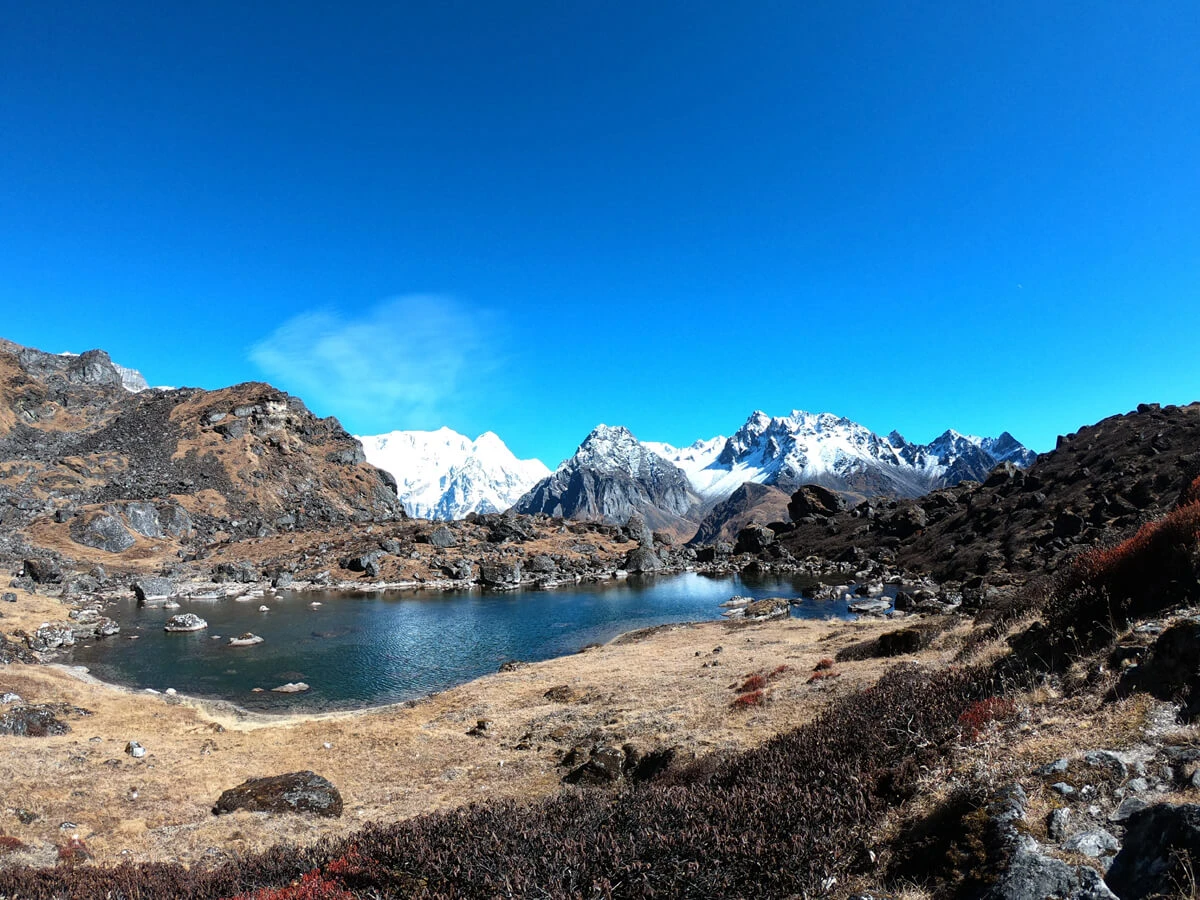
The trail goes from Ramche to Yalung Base Camp (4,500m) and then up to the Oktang Viewpoint (4,730m). This viewpoint is marked with prayer flags and a stone cairn on a high moraine wall. From this point of view, the views are breathtaking: the wide Yalung Glacier, its glacier lake sparkling below, and the beautiful peaks of Rathong (6,682m) and the Kabru Range (7,412m). The huge south face of Mount Kanchenjunga (8,598m) is the most prominent feature on the skyline, and Mount Jannu (7,710m) is at the head of the valley, looking shapeless and short, but nevertheless very powerful.
After soaking in the sights and taking pictures, you cautiously make your way back down to Cheram/Tseram. The long but amazing day is important for getting used to the new place and is the most emotional part of the whole walk.
The highest point is 4,730m (Oktang Viewpoint)
Place to stay: Lodge in Cheram/Tseram
Breakfast, lunch, and dinner are all meals.
Safety: Go slowly, drink enough of water, and keep a close eye on your guide.
Today is a day of descent after reaching the highest point of the trek. This gives your body time to recover from the high altitude. The trail goes down through alpine meadows and woodlands, going back over some of the same ground.
As you go down, the scenery seems greener and warmer. The forest becomes more lush again, and you may see more birds. Some parts are steep and need careful footing, even though they are going downhill.
By late afternoon, you go to Tortang, a tiny village amid the woods. The tea house here is basic but cozy. The air is calm, and being at a lower altitude makes you want to eat and sleep better.
Place to stay: Tortang tea house
Breakfast, lunch, and dinner
Time to walk: 6 to 7 hours
Today's hike is shorter and less stressful. The trail keeps going down through thick woods and little clearings. Along the route, you might meet locals, farmers, and kids, which will give you a taste of life in rural eastern Nepal.
There are traditional buildings and farmland throughout this part of the journey, which makes it feel culturally rich. The day is nice because the air is warmer and it's simpler to walk.
When you get to Kyangsara or Yasang, you check into a resort and spend the afternoon relaxing. This is a great chance to talk to people and think for the trip.
Lodge for lodging
Breakfast, lunch, and dinner are all meals.
Time to Walk: 4–5 Hours
The last day of trekking starts with a short, easy hike to Hellok, which is the finish of the trip. You take a vehicle to Taplejung after lunch.
The drive goes through hills, farmland, and river valleys and takes 4 to 5 hours. Taplejung is a thriving district town with greater services and a feeling of returning to civilization.
Lodging: a lodge or a hotel
Three meals a day: breakfast, lunch, and dinner
The Tamor Corridor Highway is the route we'll take today, going down from the hills to the plains. The scenery changes a lot, going from mountains to subtropical areas.
You get to Dharan, a busy city noted for its food and culture, after 4–5 hours. You may look forward to a nice stay at the hotel.
Hotel for lodging
Breakfast is the first meal of the day.
You can get to Biratnagar Airport in a short drive one to one and half hour, and then you may fly back to Kathmandu. When you arrive, you will be taken to your hotel or next destination. This is the end of a wonderful trip to the Himalayas.
Breakfast is the first meal of the day.
Kanchenjunga South Base Camp Trekking Cost Details
Includes
- Arrival and departure: all transportation (airport to hotel to airport). •.
- Transportation from Kathmandu to Bhadrapur , Biratnagar to Kathmandu by plane (weight limit: 20 kg main baggage and 5 kg hand per passenger/flight). Bhadrapur to to Taplejung, and Taplejung to Sukathum/Japantar by private jeep. Sukathum/Japantar to Biratnagar/Bhadrapur by private jeep.
- The KCAP (Kanchenjunga Conservation Area Project) and the Kanchanjunga Restricted Area Special Trekking Permit are required.
- TIMS (Trekkers Information Management System) Cards.
- Warm down your Jacket and Sleeping Bag for the trek if you needed.
- 3 meals (breakfast, lunch, and dinner) during the trek.
- Government license holder English-speaking experienced guide with their food, accommodation, salary, insurance, and equipment.
- One Sherpa (assistance guide) if the group size is more than 10 people. Plus their food, accommodation, salary, insurance, and equipment.
- First Aid medical kit will be provided during the trip, which includes an oximeter to measure oxygen levels and pulse at high altitude.
- The group will receive the King Map for the Kanchenjungha trip.
- Welcome program and farewell dinner.
- Snacks, including cookies and fresh fruits, will be provided during the trek for several days.
- Tourist service charge, VAT, government tax, and official expense if necessary.
Excludes
- All kinds of hot and cold drinks, hard and soft drinks, including drinking water, tea, coffee, chocolate, cookies, dessert, phone calls, Wi-Fi, battery charging, laundry, and hot showers.
- Your travel insurance, mandatory evacuation.
- Accommodation and Food in Kathmandu.
- If in case, the flight cancels and a charter helicopter or plane.
- If you need a porter (between 2 people) who carries 20 to 25 kg, including his own 4 to 5 kg of gear. Plus their food, accommodation, salary, insurance, and equipment.
- For tipping ideas for guides and porters (10 to 15% of your trek expenses is considered fair), however, this is from your inner heart.
- Donations and entrance fee for the school or monastery.
- Personal expenses like shopping, souvenirs or gifts, and personal mountaineering gear.
- Optional trips and sightseeing are available if extended.
- International airfare, airport departure tax, and visa fee.
- Things which don’t mention above, in our services (Trip Cost Includes).
- Visa fee: You obtain a visa (each day US$ 2 for 15 days US$ 30) easily upon your arrival at Tribhuwan International Airport Kathmandu.
Departure Dates
Except for fixed departure date, we have every day departure according to your requirements.
For over 15+ years, we have been pioneers in small group adventure travel, transforming how travelers experience the Himalayas. Discover how we are shaping the future of travel.
Add-Ons & Options
We at Nepal Mother House Treks are glad to organize an Add-on service according to your requirements for a lifetime experience in the Himalayas.
A 2:1 porter carries a total of 20–25 kg, which includes his gear weighing 4–5 kg. You may share the porter cost with your trekking partner.
Witness endangered wildlife and immerse yourself in Tharu culture. Book now for a 2-night, 3-day Chitwan Jungle Safari Tour for just $180 per person, inclusive of round-trip tourist bus transport.
Essential Information
Cost Drivers Cost Drivers:
The price of the Kanchenjunga South Base Camp trip package depends on:
- The cost of licenses for places that are off-limits
- How many persons are in the group (private or shared journey)
- The amount of staff and porters
- There is merely a tea house or maybe some places to camp.
- The season and whether or not there are flights inside the nation
- The trip's length and the extra days
- This is one of the more expensive areas to hike in Nepal because it's hard to get to and far away. When you plan your last journey to Kanchenjunga South Base Camp, you need to check the price of 2026.
Information that is helpful:
You should be patient, open-minded, and have realistic expectations for this journey.
Health: You have to be healthy enough to walk on steep ground for 6 to 8 hours a day.
Gear: You should bring a sleeping bag that can handle temperatures between -10°C and -20°C, as well as layered clothes, robust hiking boots, a down coat, gloves, a headlamp, rain jackets, and a solid daypack.
Money: Bring enough Nepalese Rupees with you from Kathmandu (NPR 1,000–2,000 per day for extras). The road doesn't have any ATMs.
Connectivity: The mobile network isn't always consistent, but NTC usually works better than other networks. Most tea shops feature Wi-Fi for a little fee, however it's not widespread or available at higher altitudes like base camp. You need a power bank because charging is limited and often costs money.
The best time of year and when to go:
March to May: The best time of year. The weather is nice, the rhododendrons are in flower, and you can see well.
Fall (September to November): A lot of people like it. The weather is dry and the mountains are clear.
Winter (December to February): Very chilly. You need to plan beforehand because snow can make high passes impassable.
Monsoon (June to August): Hard. The rain, leeches, and chance of landslides make travel hard.
Safety and Height
The Kanchenjunga area has very high altitudes and a lot of unoccupied land. Take your time to get used to the high altitude, and always do what your guide says. It's very important to have full travel insurance that covers evacuation. Need to look at the daily altitude gain and dangerous locations during the last planning. There is a lot of climbing in the Kanchenjunga South Base Camp trek itinerary. "Climb high, sleep low" is very important to us. If you have any symptoms of AMS (Acute Mountain Sickness), tell your guide right away. You need full travel insurance that covers helicopter evacuation in case you need to get to Kanchenjunga.
The Nepal Mother House Guarantee 2026:
- Safety and Power New Technology: Our guides have oximeters and satellite phones for every 9-day trip.
- Expert Logistics: We only use private 4WD Jeeps, not crowded public buses, so you can travel to the trailhead feeling good.
- Local Knowledge: We run our business like a local, thus we talk directly to the owners of the tea houses in Cheram to make sure you get the best rooms.
Last piece of advice from an expert for 2026
Don't forget the "Little Luxuries": Morale is everything on a short, hard hike. Bring along a few bars of good chocolate or a small bag of your favorite trail mix. We always provide a surprise gift for our guests at the Yalung Glacier viewpoint. It's the little things that make the "Giant" seem like home.
Equipment Lists
Mandatory Gear Checklist
For a high-intensity, 9-day"sprint" like the Kanchenjunga South Base Camp Trek, your gear choice can make or break the experience. You are moving from the tropical heat of the Terai (80m) to the sub-zero alpine environment of the Yalung Glacier (4,620m) in just a few days.
At Nepal Mother House Treks, we follow the "Light & Fast" philosophy for this route. Here is an expert-verified mandatory gear checklist for the 2026 season.
Phase 1: The Layering System (Core Clothing)
Because you will experience "Four Seasons in Nine Days."
| Item | Specification | Why? |
| Base Layers | 2x Merino Wool / Synthetic (No Cotton!) | Wicks sweat in the humidity of Yamphudin. |
| Mid-Layer | 1x Polartec Fleece or Power-stretch jacket | Traps heat during the Day 03 climb to Cheram. |
| Insulated Jacket | 1x High-loft Down Jacket (Rated to -15°C) | Essential for the sunrise at Ramche/Oktang. |
| Hard Shell | 1x Gore-Tex Jacket (Waterproof/Breathable) | Protection against unpredictable Eastern Nepal rain/snow. |
| Trekking Pants | 2x Convertible (Zip-off) pants | Transition from 30°C in Ilam to 5°C on the trail. |
Phase 2: Shoes and Extremities
Your feet are your means of transportation; take care of them.
- Trekking boots: They should be mid- to high-cut and support your ankles (you should break them in before Day 01).
- Camp Shoes: Light sandals or trainers (to let your feet breathe at the lodge).
- Socks: Three pairs of wool-blend hiking socks and one pair of thick thermal socks to wear while you sleep.
- Gloves: one pair of thin liners and one pair of waterproof insulated "Summit" gloves.
- Hats: one wide-brimmed sun hat, one thermal beanie, and one Buff/Neck gaiter (this is very important for the "Kanchenjunga Cough").
Step 3: Packs and Technical Gear
- Main Bag: a 50–60L waterproof duffel bag (if you're hiring a porter) or a 45L high-quality backpack (if you're carrying it yourself). Daypack: 20–25L for your water, camera, and rain jacket.
- Sleeping Bag: A sleeping bag that can be used in all four seasons (rated to -10°C / 15°F). If you ask, Nepal Mother House can get these for you.
- Trekking poles: Trekking poles are required. Your knees will be grateful for the 1,700m drop from Cheram to Tortang.
- Headlamp: High-lumen (LED) with two sets of extra batteries (for the early morning push to the lookout).
Step 4: The "Expert" Med-Kit and Other Important Things
- Water Purification: Katadyn filter or chlorine/iodine tablets for cleaning water. (Keep plastic waste to a minimum!)
- Protection from the sun: SPF 50+ sunscreen, lip balm, and sunglasses in category 3 or 4 (glacier blindness is a serious concern at Ramche).
- First Aid: blister kits (Compeed), ibuprofen, Diamox (for high altitudes), and rehydration salts.
- Power: 20,000mAh Power Bank (Charging is pricey and not always reliable in East Nepal).
If you're going for a 9-day hike in Kanchenjunga South, bring a 4-season down jacket, a Gore-Tex shell, and broken-in trekking boots. A sleeping bag that can handle temperatures as low as ten degrees, trekking poles for steep descents, and a high-capacity power bank are all important pieces of kit. Nepal Mother House Treks suggests a "Light and Fast" way to deal with the quick rise in altitude.
Kanchenjunga South Base Camp Trekking FAQs
You require both a Restricted Area Permit (RAP) and a Kanchenjunga Conservation Area Permit (KCAP).
Nepal's government says that anyone who wishes to hike in places that are off-limits must have a registered guide.
No. We think this is a great idea for people who have been in a high position before.
It's not hard at all. There were basic wooden apartments and outdoor areas that everyone may use at the higher elevations.
Yes, everything is within the box. But the menu grows smaller as you go up; most of it is Dal Bhat.
NTC provides the best coverage, although it doesn't always operate well in deep valleys.
You can get between NPR 1,500 and 2,000 every day, depending on how much you spend. That should be enough for the whole journey.
We normally tell our customers to be ready to stay in Kathmandu for an extra day or two if their flight is late and the weather is awful.
The program lasts for only nine days. It shouldn't be chopped any more because it's dangerous and you need to get used to it.
It's not too hard to run a tea shop, and they are usually safe. You should expect average services, shared areas, and few places to dine.
What Our Guests Say
We used the local Nepalese company Nepal Mother House to organize our Kanchenjunga circuit trek in November 2025, and I highly recommend this company.
The Kanchenjunga circuit was the second trek I booked with Nepal Mother House and company owner Karna, the first being...
A huge thank you to Karna, Sabut, and Ganesh at Nepal Mother House Treks for organizing an amazing trek on the Kanchenjunga Circuit.
Our guide, Sabut, was fantastic. He had incredible insight into the local geography and terrain, paired with a great sense of humor...
Karna, and Nepal Mother House trekking company did an excellent job from start to finish for our successful 3-week trek to the north & south base camps of the remote Kanchenjunga area, in eastern Nepal in Oct/Nov 2018. I contacted Karna from Canada a couple months before, and was immediately responded...